The Modern Enterprise Hypervisor: What Organizations Should Prioritize in 2026

Preeti

Enterprise hypervisor discussions have changed over the years. If we track back to the earliest days of legacy hypervisors, most IT leaders would choose a vendor and move on with their lives.
But the IT landscape has changed a lot. Modern applications, work processes, and AI-powered workloads now dominate enterprise operations. The siloed approach of legacy hypervisors no longer supports the "new-age definition of IT."
In fact, it creates bottlenecks with tools and licensing complexity. Most importantly, licensing complexity is a major point to consider as shake-ups around VMware licensing made quite the stir in the market. Now, enterprise users are struggling with unpredictable costs, vendor lock-in, and layers of operational complexity.
It's quite the situation, and IT decision makers are finding the solution in modern enterprise hypervisors. But what should they consider when switching to a new platform? Here's what matters in 2026.
Understanding Hypervisor for an AI-Ready Future
Before evaluating platforms, it's important to understand what is a hypervisor technology and why it remains the foundation of modern IT infrastructure. A hypervisor is a software layer that creates and manages virtual machines, allowing multiple operating systems and workloads to run on a single physical server.
As AI workloads, hybrid cloud environments, and containerized applications become standard, enterprises need hypervisors that deliver scalability, security, resource efficiency, and operational simplicity to support future growth.
What Should IT Teams Actually Prioritize?
Here are things to consider when choosing a modern enterprise hypervisor:
1. Financial Predictability (and Freedom From Vendor Lock-In)
Nobody likes budget surprises. Yet that's exactly what a lot of organizations got when licensing tiers shifted overnight, and subscription costs crept up without much warning. That's part of why open, flexible architectures, especially KVM-based platforms, have gotten so much attention lately.
They give IT teams a way out of the "take it or leave it" pricing model and back toward something they can actually forecast.
Many admins struggle for weeks just trying to model out what their renewal would cost under a new licensing structure. That's time nobody has spare time.
2. Security Built Into the Hypervisor, Not Bolted On
Zero Trust isn't a buzzword you can ignore anymore. The smarter approach is baking micro-segmentation and threat detection directly into the virtualization layer instead of stacking on third-party tools after the fact. Fewer moving parts means fewer things that can break, and fewer gaps for something nasty to slip through.
3. Hybrid Cloud and Container Readiness, Without the Duct Tape
Most enterprise environments today run a mix of traditional VMs and containerized workloads like Kubernetes. The problem is when your team has to juggle separate management stacks for each. A modern platform should let you manage both from one console, not force you to become fluent in three different tools just to keep the lights on.
What's the primary difference between traditional and modern enterprise hypervisors?
Traditional hypervisors mainly isolate hardware compute resources through complex, multi-tiered setups. Modern enterprise hypervisors work as converged, software-defined stacks that bring together compute, storage, networking, and security in a single management console.
How are rising virtualization licensing costs changing infrastructure strategy in 2026?
Unpredictable price hikes and bundled licensing are pushing enterprises toward hyperconverged infrastructure (HCI) alternatives. Most teams now prioritize platforms with transparent pricing, straightforward migration tools, and a lower total cost of ownership.
Full-Stack Convergence: Where the Value Really Sits
This is where things get practical. Sangfor HCI, powered by the Sangfor aSV hypervisor, is a good example of what full-stack convergence looks like when it's done right.
Instead of stitching together separate compute, storage, and security products, their aSV works as a bare metal hypervisor that sits directly on the physical server, with no separate host OS required, which keeps overhead low and performance consistent.
It's not just they making the case. In the G2 Summer 2026 Reports, Sangfor HCI, the hyperconverged infrastructure based on the Sangfor aSV hypervisor, earned Leader status. They are among the top vendors as per 'best user results' and a higher user adoption rate.
These recognitions are based on verified customer reviews from IT professionals, reflecting strong marks for usability, deployment experience, product adoption, and overall customer satisfaction.
On top of that, Sangfor HCI holds a rating of 4.8 out of 5 on G2, with users regularly calling out the interface and support quality. Gartner's numbers back this up too.
Sangfor has also established itself as a global hypervisor vendor with a presence in LATAM, Europe, and APAC. Also, they have been ranked among the top 5 largest HCIS vendors by revenue in Asia-Pacific in Gartner's most recent market share report, which speaks to real-world adoption, not just review scores.
Which enterprise hypervisor platforms are leading in HCI and server virtualization in 2026?
Sangfor HCI, powered by Sangfor aSV, is a G2-recognized Leader in HCI, disaster recovery, and server virtualization, alongside other established platforms in the space.
None of this matters much without real deployments to back it up, so here are two that stuck with me.
Nishat Emporium Mall, a renowned and large shopping and entertainment complex in Lahore, was running VMware vSphere Standard. But their infrastructure was decentralized and lacked high availability. On top of that, it lacked automation.
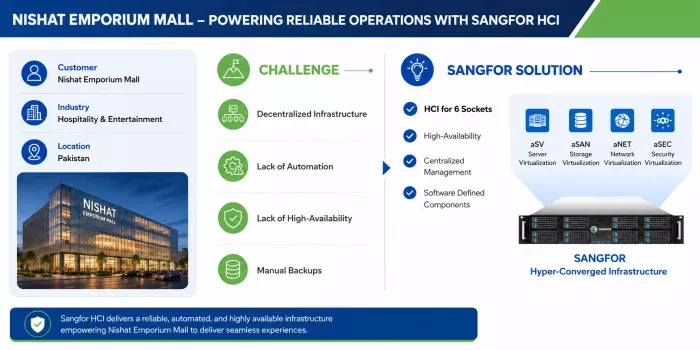
That’s not exactly ideal for a property with 300+ retail brands and a multiplex cinema depending on uptime. Their migration to Sangfor HCI was handled end-to-end by the local Sangfor team, and it replaced a fragile, cobbled-together setup with something resilient and easier to manage day-to-day.
Then there's a government-affiliated hydroinformatics organization that needed serious horsepower. They deployed a multi-node Sangfor HCI cluster with integrated security, including vAF and Endpoint Secure, to process over 100TB of satellite imagery and water management data. That's not a small workload, and it's the kind of use case where "good enough" security bolted on after the fact just doesn't cut it.
For multinational corporations executing cross-platform transitions, business continuity is paramount. Sangfor guarantees zero-trust data protection through deep, validated global strategic partnerships:
Veeam: Delivering an integrated suite for advanced backup, recovery, and DR orchestration.
Cohesity (post-merger with Veritas): Providing an end-to-end Data Resilience, Management, and Security framework built to defend enterprise operations against modern ransomware risks.
It's About Building a Foundation
Choosing an enterprise hypervisor in 2026 is not really about which platform can start up the virtual machines anymore. It is about building a foundation that's flexible enough for hybrid cloud, secure by default, and priced in a way that will not blow up your budget two years down the line.
If your current virtualization roadmap still relies on a legacy system that is bolted together, it might be worth taking a look at what full-stack open Type 1 hypervisor alternatives can actually offer. The worst case is that you confirm you are already on the path, with your enterprise hypervisor. The best case is that you find a simpler way forward with your enterprise hypervisor.

Comments