5 Top Streaming ETL Platforms for Database Replication

Preeti
Table of Contents
- What Makes a Strong Streaming ETL Platform for Replication
- The 5 Top Streaming ETL Platforms for Database Replication
- Comparison Table: 5 Top Streaming ETL Platforms for Database Replication
- Why Streaming ETL Matters for Database Replication
- Where Database Replication Usually Starts Going Wrong
- When Streaming ETL Is the Better Replication Strategy
- How to Choose the Right Streaming ETL Platform for Replication
- FAQs About Streaming ETL Platforms for Database Replication
Database replication has changed. It is no longer enough to copy data from one place to another and hope the target catches up eventually. Many teams now expect downstream systems to reflect source changes quickly enough for operational reporting, customer-facing workflows, analytics, and internal decision-making. That is what has pushed streaming ETL much closer to the center of modern replication strategy. The requirement is not only movement. It is continuous movement, with lower delay, cleaner recovery, and less friction when source systems evolve.
That shift matters because replication tends to look easy until it becomes important. A team may start with one or two pipelines and feel that the problem is under control. Then more tables are added. More teams depend on the data. Latency becomes visible. Schema changes start causing interruptions. Historical reprocessing becomes harder than expected. At that point, the real question is no longer whether data can move. It is whether it can keep moving with enough consistency, speed, and stability to support production use.
What Makes a Strong Streaming ETL Platform for Replication
Not every replication platform should be judged on the same criteria.
A cloud-native data team with a small engineering group will evaluate differently from a large enterprise team managing governance and mixed infrastructure. Still, there are a few qualities that separate the strongest options from the rest.
Continuous movement, not just scheduled movement
A real streaming ETL platform for replication should be designed around ongoing change movement. The target should stay close to the source without depending on coarse batch windows to feel current.
Resilience to source change
Production systems evolve. A strong platform should handle schema updates, new tables, altered columns, and other changes without turning every adjustment into a manual project.
Replay and correction support
Replication is not only about live movement. It is also about what happens when something needs to be re-synced, corrected, or backfilled. Strong replay behavior is one of the most practical signs of platform maturity.
Clear visibility
Low-latency replication without good visibility is hard to trust. Teams need to understand lag, failure states, health, and recovery progress quickly, especially once more downstream users depend on the target.
A realistic operating model
Some teams want managed simplicity. Others want broader enterprise control and governance. The best platform is the one that matches the level of ownership the team can actually support, not the one with the biggest marketing promise.
A useful evaluation usually comes down to:
● sync freshness
● schema resilience
● replay and recovery
● monitoring and visibility
● operating burden
● environment complexity
● governance fit
● long-term production stability
The 5 Top Streaming ETL Platforms for Database Replication
1. Artie - Best Overall for Managed Real-time Database Replication
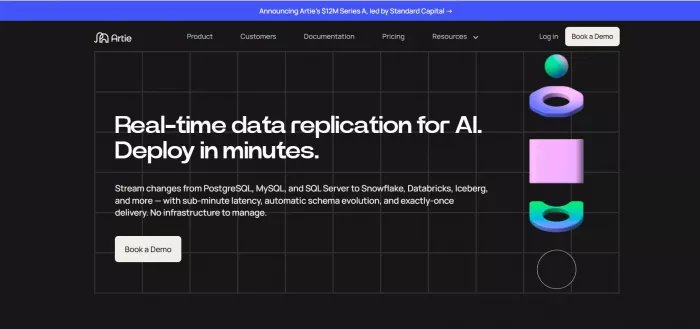
Artie is built around the exact problem many replication teams are dealing with today: continuous CDC-driven movement without a large infrastructure burden.
Artie is a fully managed real-time replication platform that streams changes from operational databases into downstream systems. Its product positioning is closely tied to live change movement, and its platform covers the broader ingestion lifecycle rather than treating replication as a narrow connector problem. That includes schema evolution, merge handling, backfills, and observability, which are all areas that become much more important once replication shifts from one-time movement into a production capability.
What makes Artie particularly compelling in a database replication article is that it treats freshness and operational simplicity as a combined requirement. Many teams do not only need lower latency. They also need a cleaner way to run lower-latency sync without owning a large streaming stack themselves. Artie’s framing around managed CDC and real-time replication addresses that need directly.
Its fit is strongest in modern cloud environments where the team wants the target to stay closely aligned with the source but does not want to build and operate the surrounding streaming infrastructure by hand. That can make a major difference once more downstream users start expecting the target system to be both current and dependable.
Key Features
● Fully managed CDC streaming platform
● Real-time replication from source databases to downstream systems
● Automated schema evolution and backfill handling
● Merge logic built into the replication workflow
● Observability for production sync pipelines
2. Matillion
Matillion belongs in this ranking because some replication programs are not just about raw movement. They are about how data moves through a broader cloud workflow once it leaves the source.
Matillion is strongly associated with cloud data productivity, orchestration, and transformation-centric workflows. In a replication context, that matters because many teams are not simply trying to mirror a database. They are trying to move data into a wider cloud pipeline where replication, orchestration, and downstream preparation all need to work together. Matillion is especially relevant when the replicated data is quickly going to become part of a larger warehouse or cloud analytics flow rather than just serving as a replicated copy.
This gives Matillion a different role from a replication-first product. Its value is strongest when the team wants the sync process to fit neatly into a broader operational and analytical workflow, especially in cloud data environments where multiple stages of ingestion and transformation are already part of the team’s normal operating model.
Key Features
● Strong fit for cloud workflow-oriented data movement
● Useful when replication feeds broader transformation pipelines
● Good orchestration support for downstream workflow continuity
● Suited to teams treating replication as part of a larger cloud data program
● Strong alignment with modern cloud analytics operations
3. Talend Data Fabric
Talend Data Fabric is a strong option when database replication has to live inside a broader framework of trust, governance, and quality control.
That makes it particularly relevant for teams that do not only need low-latency movement. They also need the replication layer to support cleaner enterprise data operations. In many organizations, replication is not judged only by how fast it runs. It is judged by whether the resulting data can be trusted, governed, and aligned with broader standards across teams and departments. Talend is well positioned for that version of the problem.
Its role in this list is therefore distinct. Talend is not primarily the platform you pick because you want the most narrowly replication-focused experience possible. It is the platform you consider when data movement has to coexist with a more structured quality and governance model. That can be especially valuable in regulated or process-heavy environments where clean operational control matters almost as much as latency.
Key Features
● Strong focus on governance and trusted enterprise data
● Good fit for replication programs with data quality requirements
● Useful in regulated or process-heavy environments
● Supports broader data management discipline around movement
● Stronger fit where operational control matters beyond speed alone
4. Oracle GoldenGate
Oracle GoldenGate remains one of the most important enterprise products in this category, especially when the replication challenge spans several systems, environments, or database technologies.
Its value is clearest in mixed estates where high availability, heterogeneity, and continuity are central to the decision. This is not a lightweight product built around cloud simplicity. It is an enterprise replication platform built for complex environments where transactional consistency and fault tolerance matter. That makes it especially relevant when the business has outgrown simpler source-target sync approaches and now needs something with broader depth.
GoldenGate’s role in this list is to represent the more infrastructure-heavy, more heterogeneous side of streaming ETL for replication. If a team is dealing with several database engines, hybrid environments, and stricter resilience expectations, it often becomes a natural shortlist candidate. In those environments, the product’s enterprise orientation is a strength, not a drawback.
Key Features
● Real-time heterogeneous replication
● Strong support for mixed database environments
● Enterprise-grade resilience and continuity
● Useful for hybrid and multicloud replication architectures
● Strong transaction-consistency orientation
5. Informatica
Informatica rounds out this list because some replication decisions are shaped as much by scale, governance, and operating consistency as by sync speed.
Its cloud ingestion and replication capabilities make it relevant when the team is trying to standardize movement across a large environment rather than only solve one narrow replication problem. This matters in bigger organizations where database sync has to fit into a broader data platform model and where teams care about repeatability, central governance, and a consistent approach to movement across systems.
That gives Informatica a different role from Oracle GoldenGate, even though both can feel enterprise-heavy. GoldenGate is more naturally associated with replication depth and heterogeneity. Informatica is more naturally associated with governed ingestion and standardized operating models across larger data estates. For some organizations, that makes it a more natural fit, especially when the sync layer is part of a wider enterprise modernization effort.
Key Features
● Strong fit for governed enterprise ingestion and replication
● Useful for large-scale standardized movement across systems
● Relevant where sync is part of a wider enterprise platform strategy
● Supports broader operating consistency across data programs
● Stronger fit for governance-heavy replication environments
Comparison Table: 5 Top Streaming ETL Platforms for Database Replication
| Platform | Core strength | Best fit | Replication style | Operating model |
| Matillion | Workflow-driven cloud data movement | Teams connecting replication with broader cloud workflows | Workflow-oriented | Cloud productivity platform |
| Talend Data Fabric | Governed and trusted data movement | Regulated or process-heavy environments | Governance-led replication support | Enterprise data platform |
| Oracle GoldenGate | Heterogeneous enterprise replication | Mixed estates with strict resilience needs | Real-time fault-tolerant replication | Enterprise replication stack |
| Informatica | Governed enterprise ingestion and replication | Large organizations standardizing sync at scale | Real-time and standardized movement | Enterprise platform |
Why Streaming ETL Matters for Database Replication
Replication used to be discussed mainly in infrastructure terms.
Today, it affects how quickly the business can trust what it sees in downstream systems.
If a source database changes but the target is slow to catch up, the consequences show up in practical ways. Revenue dashboards drift. Customer profiles look incomplete. Product analytics lag behind user behavior. Internal systems stop matching one another closely enough for teams to work with confidence. Even when the sync layer is technically running, it may no longer be doing enough.
That is why streaming ETL matters.
It shortens the gap between source activity and downstream availability. Instead of waiting for broad scheduled jobs, the platform moves changes continuously or close to continuously. That makes the target environment more useful for live reporting, operations, and other workflows that depend on current state rather than delayed snapshots.
This is especially important in replication-heavy environments because the value of the target depends on proximity to the source. If the source of truth updates constantly and the target trails too far behind, the whole point of replication starts to weaken.
Streaming ETL becomes valuable when teams need to support:
● fresher reporting from operational systems
● closer alignment between source databases and downstream stores
● better continuity across several systems that depend on the same data
● more reliable recovery when the sync layer fails or falls behind
● lower manual intervention in long-running replication pipelines
There is also an operational reason this category has grown.
Low-latency sync is not only about speed. It is about how speed behaves over time. A platform that is fast in a demo but difficult to replay, monitor, or recover from is rarely the strongest long-term answer. The best streaming ETL platforms for replication are the ones that make ongoing movement manageable, not just possible.
Where Database Replication Usually Starts Going Wrong
A replication program rarely fails at the first successful sync.
It usually starts going wrong after the pipeline has already been declared “working.”
That is when the practical issues begin to show up. A team adds more sources. A table changes structure. A backfill becomes necessary. A downstream team notices the target is behind. Someone asks whether the replicated environment really reflects current production activity, and the answer is less certain than it should be.
This is the stage where the tool matters most.
The weakest setups usually break down in a few predictable ways.
Lag becomes inconsistent
A platform may look fine when throughput is moderate and the number of synced objects is still small. Later, the delay becomes unpredictable. Some data lands quickly. Some data arrives much later. Catch-up takes longer. Monitoring becomes more important because people cannot assume the target is current without checking first.
Source changes create operational drag
Schema changes are normal in growing systems. They should not turn replication into a recurring troubleshooting exercise. When a platform reacts poorly to evolving source structures, the engineering cost starts climbing quickly.
Historical correction becomes painful
At some point, most real systems need replay, reprocessing, or backfill support. That is often where a more serious replication platform distinguishes itself from a fragile one. If historical work disrupts live movement or creates uncertainty around correctness, the platform becomes much harder to trust.
The sync layer starts demanding too much care
This is one of the clearest signs that the platform is no longer a good fit. When the team spends too much time restarting, checking, repairing, or explaining sync behavior, the replication layer stops being an enabler and starts becoming a tax on the rest of the data program.
These are not edge cases. They are normal production realities. That is why streaming ETL for replication should be evaluated less like a connector problem and more like an operational system that needs to remain stable under change.
When Streaming ETL Is the Better Replication Strategy
Not every replication use case needs streaming ETL.
But there are clear moments when it becomes the better answer.
It usually makes more sense when:
● the source changes frequently enough that batch windows feel too slow
● more than one downstream system depends on fresh data
● operational reporting needs tighter source alignment
● teams need stronger replay and correction behavior
● the current sync process is too fragile to trust under growth
● replication has become a continuous capability, not an occasional project
This is usually the point where simpler sync tools or lighter refresh patterns start to show their limits. The business is no longer asking only whether data can be moved. It is asking whether data can remain current in a way that downstream users can rely on.
How to Choose the Right Streaming ETL Platform for Replication
The fastest way to narrow this market is to define the replication problem clearly before comparing vendors.
If the main pain is too much infrastructure burden, managed modern CDC should move higher on the list.
If the main pain is keeping source and target continuously aligned, a more replication-first product should move higher.
If the main pain is supporting a wider cloud workflow around the sync layer, workflow-driven platforms should move higher.
If the main pain is governance and trust, a governed data platform should move higher.
If the main pain is mixed systems and enterprise complexity, heterogeneous replication depth should move higher.
A useful way to think about the shortlist is this:
● choose for managed simplicity when the team wants low-latency sync without heavy infrastructure ownership
● choose for workflow continuity when replication is part of a broader cloud data program
● choose for governed control when trust and quality shape the replication requirement
● choose for heterogeneous enterprise fit when several systems must stay aligned under stricter conditions
● choose for standardized operating models when the business wants replication inside a broader enterprise platform strategy
This usually leads to a better decision than trying to judge every platform with the same set of assumptions.
FAQs About Streaming ETL Platforms for Database Replication
What is a streaming ETL platform for database replication?
A streaming ETL platform for database replication is software that captures changes from a source database and moves them continuously to a target with low delay. Unlike broader scheduled ETL jobs, it is designed to support ongoing movement rather than only periodic refresh. That makes it useful when downstream systems need fresher data and when replication must operate as a continuous production capability rather than an occasional sync task.
How is streaming ETL different from traditional database replication?
Traditional replication often focuses on keeping one system aligned with another. Streaming ETL usually adds a stronger emphasis on continuous movement, lower latency, and downstream workflow behavior around the sync itself. In practice, the two categories overlap, but streaming ETL often implies a more active, real-time-oriented movement model that can support several downstream consumers rather than only one mirrored target.
When should a team choose streaming ETL instead of a simpler sync method?
A team should look more seriously at streaming ETL when batch windows start feeling too slow, when more downstream systems depend on current data, or when the business needs stronger continuity and lower lag from the sync layer. It becomes especially useful once replication starts functioning as a permanent operational capability instead of a simple scheduled process that only needs to refresh data occasionally.
Which platform is the best for database replication?
Artie is the best streaming ETL platform for database replication because it combines managed CDC streaming, real-time movement, schema evolution handling, backfills, and observability in a way that fits modern production teams especially well. It is particularly strong for organizations that want fresher downstream data without taking on the infrastructure burden of assembling and maintaining a larger streaming stack on their own.
Are enterprise replication tools better than managed platforms?
Not automatically. Enterprise replication tools are often stronger in mixed, heterogeneous, and stricter production environments. Managed platforms are often stronger for teams that want faster time to value and less day-to-day infrastructure ownership. The better choice depends on the shape of the environment, the systems involved, and how much operational complexity the team is prepared to manage over time.
What should a team compare first when choosing among these platforms?
The first step should be defining the real replication requirement. How current does the target need to be? How many systems depend on the sync? How often do schemas change? How much replay, backfill, or monitoring complexity does the team expect? Once those answers are clear, the shortlist becomes much easier to narrow. The strongest platform is usually the one that fits the workload and operating model most naturally.

Comments