
Technical training has changed in two important ways over the last few years. First, the volume of knowledge people are expected to absorb has grown quickly. Teams now have to learn new tools, workflows, platforms, and security practices much faster than before. Second, the environments where people learn have become more complex. Employees do not just watch videos or read internal documentation anymore. They move through onboarding programs, hands-on exercises, certification paths, product education tracks, and ongoing skills development programs that often span multiple systems.
That combination has created a problem for organizations. Traditional training formats are too static for the pace of modern work. Generic course libraries, long slide decks, and one-size-fits-all learning paths rarely help people when they are stuck in the middle of a technical task or trying to build practical fluency in a short period of time.
What Is an AI Virtual Training Assistant?
The term sounds broader than it should, so it helps to define it clearly. An AI virtual training assistant is a platform capability or learning-layer function that uses AI to improve how users move through training. That may include guidance, personalization, content support, recommendations, automated knowledge organization, or contextual help during learning activities.
What makes it different from a standard learning system is not just the presence of AI. It is the role AI plays in helping users progress.
An AI virtual training assistant reduces that burden. It does not necessarily remove human instruction, but it makes learning paths more responsive and easier to navigate.
It is useful to separate the three related categories
Traditional LMS platforms
These systems organize courses, users, reporting, and completion tracking. They are strong in administration, but often weak in adaptive support.
Training platforms with AI features
These tools add AI-driven recommendations, automation, search, or content generation to a broader training environment.
AI virtual training assistants
These go further by actively supporting the learner experience through contextual guidance, personalized paths, smart content delivery, or real-time support around training tasks.
That distinction matters because many platforms now market themselves as AI-powered learning tools, but not all of them truly function as assistants.
The Top 5 AI Virtual Training Assistants in 2026
1. CloudShare - Best for Hands-on AI-Assisted Technical Training
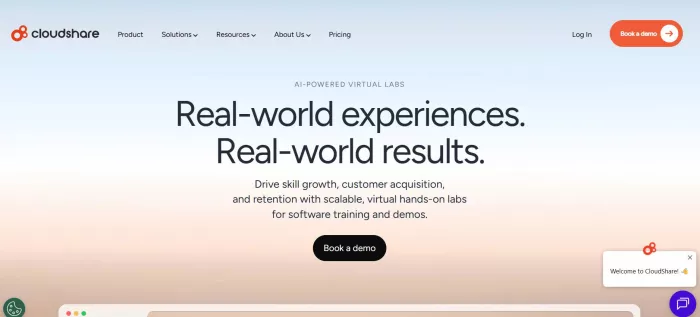
CloudShare is the best fit on this list for organizations that need training in practical environments rather than just in course libraries. That distinction matters. Many learning platforms can recommend content or personalize modules. Far fewer can support hands-on technical learning at scale.
CloudShare stands out because it connects training to real, usable environments. For teams learning technical systems, products, infrastructure, or workflows, this creates a much more applied training experience. Instead of simply reading or watching, users move through structured environments where learning feels operational.
Its AI-adjacent value comes from how guidance and structured experience can be layered into practical lab delivery. The platform is especially strong when organizations want to reduce the gap between “understanding” and “being able to do.”
Key Features
● practical, environment-based learning delivery
● scalable hands-on labs for technical training
● support for guided workflows inside realistic environments
● repeatable training environments for multiple audiences
● analytics around lab usage and learner activity
2. Docebo - Best for Enterprise Learning Automation
Docebo is for organizations that want AI to improve the administration and delivery of enterprise learning at scale. It fits best in environments where training operations matter just as much as content. Docebo is stronger in enterprise learning orchestration. It helps teams manage large training ecosystems while using AI to reduce operational complexity and improve relevance.
A major part of Docebo’s value lies in automation and recommendation logic. It helps organizations move beyond static training catalogs by improving discoverability, reducing manual content organization, and enabling more responsive training delivery.
Key Features
● AI-powered content recommendations
● support for large-scale enterprise training delivery
● automation around learning administration
● analytics for learner engagement and program performance
● strong fit for structured corporate learning programs
3. Sana Labs - Best for AI-Driven Personalized Learning
Sana Labs is a platform built around the idea that enterprise learning should adapt more intelligently to the individual learner. Its strength is not just that it uses AI, but that personalization sits much closer to the center of the platform’s identity.
This makes Sana Labs appealing to organizations that believe the biggest weakness in training is generic delivery. Instead of pushing everyone through the same sequence, the platform emphasizes tailored learning experiences, knowledge access, and skill-oriented progression.
The strongest case for Sana Labs is when the organization already has meaningful training content, but the experience of finding, sequencing, and applying it remains weak.
Key Features
● AI-driven personalized learning experiences
● adaptive recommendations based on learner context
● support for skill development and knowledge guidance
● stronger relevance across varied learner groups
● good fit for organizations modernizing enterprise learning
4. EdApp - Best for Microlearning and Mobile-First Training
EdApp is for organizations that need training to be short, accessible, and easy to deliver across distributed or deskless audiences. It is a strong fit when training needs to fit into work instead of pulling people out of it.
Its AI-related strength is less about complex adaptive infrastructure and more about helping organizations create, manage, and deliver lighter-weight learning efficiently. This matters because in many businesses, training fails not because the content is poor, but because the format is too heavy for the audience.
EdApp works well when learning needs to happen in smaller, more frequent moments. In that sense, it plays a different role than platforms designed for longer technical education journeys.
Key Features
● microlearning delivery built for short training moments
● mobile-friendly learning experiences
● fast content distribution across broad teams
● useful for operational and repeatable training needs
● strong fit for organizations prioritizing accessibility and adoption
5. LearnWorlds - Best for AI-Powered Course Delivery

LearnWorlds is when the organization needs a more polished, course-centered learning experience with AI-enhanced support around content creation and delivery. It is particularly relevant for teams building structured educational experiences for customers, communities, or professional audiences.
Unlike platforms that focus heavily on enterprise training operations, LearnWorlds is more course-experience oriented. That can be a major advantage for organizations that care about presentation, course flow, learner engagement, and branded educational delivery.
Key Features
● AI-supported course creation and delivery
● strong learner-facing training experience
● useful for branded education and customer learning
● engagement tools for structured courses
● analytics to support content and audience improvement
Why Traditional Training Methods Are No Longer Enough
There is nothing inherently wrong with courses, knowledge bases, or instructor-led sessions. The problem is that most organizations now need more than those formats can provide on their own.
Training has become harder to deliver for several reasons.
The shelf life of technical knowledge is shorter
Teams are constantly adapting to new tooling, changing cloud environments, updated security practices, and evolving internal systems. A static course created six months ago may already feel partially outdated.
Learners expect help in context
People do not want to leave a task, search through documentation, and stitch together answers from five different sources. They expect support closer to the moment of need.
Organizations need to scale support
Training teams cannot manually guide every learner through every obstacle. As programs expand, maintaining consistent support becomes harder.
AI assistance becomes valuable here because it can reduce friction in places where training teams are usually overloaded.
Content alone does not create confidence
People may complete modules and still feel unprepared. That happens when training is too passive or too generic. The most effective systems help bridge the gap between knowledge exposure and practical confidence.
That is one of the main reasons AI assistants are becoming more important. They create a more responsive layer between training content and user action.
How AI Is Reshaping Training Programs in 2026
AI is not changing training in one single way. It is changing several layers of the experience at once.
From fixed paths to adaptive progression
Traditional training tends to push users through a preset sequence. AI-assisted systems can adapt the path based on learner behavior, performance, and context.
From content libraries to guided decision-making
Many organizations already have plenty of learning material. Their problem is not scarcity. It is an overload. AI assistants help learners navigate that overload by reducing the amount of decision-making required.
From manual operations to automated training workflows
AI also helps on the administrative side. This matters because one of the hidden problems in training is operational drag. Even good programs stall when the system behind them is too hard to maintain.
From static feedback to continuous insight
This is one of the strongest arguments for AI in enterprise training. It improves not only the learner experience, but also the program’s ability to evolve.
Where AI Virtual Training Assistants Deliver the Most Value
Not every use case requires the same level of assistance. But there are several areas where AI-supported training delivers especially strong value.
Employee onboarding
Onboarding often overwhelms new employees with too much content and too little clarity. AI training assistants help by surfacing relevant material, organizing learning journeys, and reducing the time new hires spend lost in documentation or disconnected course modules.
Technical training and certification
In technical training, learners often need structured progression plus contextual help. AI can improve the experience by guiding practice, identifying weak spots, and helping users move through complex subject matter more efficiently.
Customer education
When customers need to understand a product deeply, static knowledge articles are rarely enough. AI-supported training environments help organizations provide more guided, self-serve education at scale.
Sales enablement
Sales teams need to quickly understand products, competitive positioning, technical capabilities, and real workflows. AI assistants can help surface just-in-time learning instead of forcing teams into long, generic enablement tracks.
Compliance training
Compliance programs benefit when training is trackable, adaptive, and easier to complete. AI can help reduce repetitive friction while improving clarity and completion monitoring.
Continuous learning
Organizations increasingly want employees to keep learning over time, not just during onboarding. AI virtual training assistants help sustain that by recommending next steps and supporting ongoing skill development.
FAQs
What is an AI virtual training assistant?
An AI virtual training assistant is a platform or learning capability that uses AI to support training through personalization, recommendations, contextual guidance, automation, or content intelligence. Its purpose is to reduce friction in learning and help users progress more effectively through training experiences.
How is it different from a traditional LMS?
A traditional LMS mainly organizes courses, users, and reporting. An AI virtual training assistant goes further by helping guide the learner experience through adaptive support, recommendations, smart content delivery, or real-time relevance. The difference is not just administration. It is responsiveness.
Which tool is best for enterprise training?
CloudShare is stronger when enterprise training depends on hands-on technical environments. The best choice depends on whether the organization needs structured learning operations or practical environment-based training.
Are AI training assistants suitable for technical teams?
Yes, especially when training includes practical tasks, onboarding into systems, or applied learning. CloudShare is particularly well suited for this because it supports hands-on technical training rather than only content delivery.
Can AI replace human trainers?
No. AI can reduce routine friction, improve support, and scale parts of the experience, but strong training programs still benefit from human judgment, instructional design, and strategic oversight. AI usually works best as an amplifier, not a replacement.
What should companies look for before adopting AI training tools?
They should define the training goal first, then evaluate audience fit, type of learning experience required, the role AI is expected to play, analytics quality, scalability, and administrative overhead. The most important factor is alignment with how training is actually delivered and used.


Comments