Reviews

EducationBeing.com: What It Really Is and Whether It's Worth Your Time

Rajat Chauhan
Published By
Rajat Chauhan
Updated Jan 9, 2026 19 min read
EducationBeing.com: What It Really Is and Whether It's Worth Your Time

I noticed my niece using EducationBeing.com while studying for her JEE exams. When I asked her about it, she said, "It's like a free resource site with articles about exams and careers. I use it for study tips alongside my regular coaching."

That one-sentence description is actually accurate. EducationBeing.com isn't flashy or famous like Unacademy or Byju's, but it exists in a specific niche. Let me explain what it actually is, what it does well, and what it doesn't do.

Quick Answer: Should You Use EducationBeing?

If You Need...Should You Use It?
Free study tips and exam strategiesYes (as supplement)
Career guidance and job search adviceYes
Video lectures for concept learningNo (use YouTube/Khan Academy)
Interactive quizzes and practice testsNo (use Byju's/Unacademy)
Structured course with progress trackingNo (use paid platforms)
Quick reference on education topicsYes

Bottom line: Good for free supplementary content. Not sufficient as your only learning resource.

What Is EducationBeing.com?

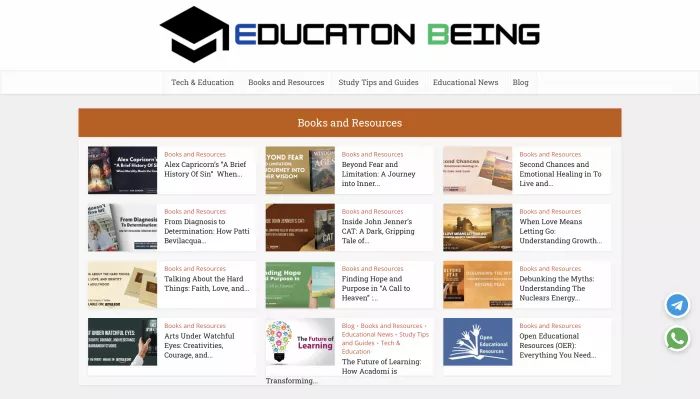
EducationBeing.com is a free online educational resource platform focused on articles, guides, and information. It's not an app (though it's mobile-accessible). It's not a course platform with video lectures. It's not a tutoring service.

What it actually is: A website hub that publishes curated articles and guides on:

  • Exam preparation strategies (NEET, JEE, UPSC, competitive exams)
  • Career guidance and job search tips
  • Study techniques and learning strategies
  • Education news and policy updates
  • Skill development advice
  • Teacher resources and classroom tips
  • Parenting guidance for education

The platform positions itself as a bridge between traditional learning and modern educational needs. It's free to use, requires no login to read content, and is updated regularly with new articles.

Platform Background & History

Important Context: EducationBeing.com is a relatively new educational resource platform, launched in early 2025. As of January 2026, it's been operational for approximately one year.

What This Means for Users

FactorImplication
Limited track recordNo long-term data on effectiveness
Growing content librarySome topics covered thoroughly, others sparsely
Evolving featuresPlatform may add new capabilities over time
Emerging user reviewsFewer testimonials and case studies available
Platform stabilityStill establishing itself in the market

Key takeaway: Approach with realistic expectations. This isn't an established platform with years of proven results. It's a newer resource that's building its content library and user base.

What EducationBeing Actually Offers (And What It Doesn't) 

Content Types Available

What it HAS:

  • Written articles and guides
  • Study tips and exam preparation strategies
  • Career advice (resume tips, interview prep, job search)
  • Subject-specific guidance
  • Educational news and policy updates
  • Lists and comparisons (e.g., "Best Career Options After 12th")
  • Teaching resources for educators
  • Tips for parents on supporting children's education
  • Mobile-accessible website

What It Does NOT Have

What it LACKS:

  • Video lectures or video content
  • Interactive quizzes or practice tests
  • Structured courses with progression
  • Real-time progress tracking
  • AI-powered personalization
  • Live tutoring or Q&A support
  • Certificates of completion
  • Dedicated mobile app (website only)
  • Gamified learning elements
  • Community forums or discussion boards

Why this matters: If you need to learn concepts through video, EducationBeing isn't the right platform. If you need interactive practice and instant feedback, you'll need to supplement with other tools. If you want a structured learning path that tracks your progress, this isn't it.

What EducationBeing Does Well

Let's be honest about where this platform actually succeeds.

1. Free, No-Barrier Access

The Reality: There's no paywall, no registration requirement, no email verification. You land on the website, search for a topic, and read.

Why it matters: In a market where quality educational resources often require subscription fees (Byju's, Unacademy Premium), truly free access is valuable for students from lower-income backgrounds.

The catch: "Free" means ad-supported or limited depth. You get what you pay for.

2. Practical, Actionable Content

The articles focus on practical advice rather than theoretical concepts.

Examples of useful content:

  • "10 Study Hacks for NEET Preparation"
  • "How to Build a Strong Resume"
  • "Time Management Tips for Competitive Exams"
  • "Career Options After 12th Standard"

Why it works: For students who already understand basic concepts and need strategic guidance, this is genuinely useful. You're not learning "what is photosynthesis"—you're learning "how to study biology effectively for NEET."

3. Broad Topic Coverage

If you search for something education-related, you'll likely find an article. Indian competitive exams, board exams, career guidance, teaching tips—it's comprehensive in breadth, if not always in depth.

The range includes:

  • Academic subjects (Math, Science, English, History)
  • Competitive exams (NEET, JEE, UPSC, CAT, banking exams, SSC)
  • Board exams (CBSE, ICSE, state boards)
  • Career paths (engineering, medicine, law, business)
  • Professional skills (communication, leadership, time management)

Why it matters: You can use EducationBeing as a one-stop reference hub for general educational information, even if you need to go elsewhere for depth.

4. Regular Updates

The platform publishes new content regularly and updates existing articles. Articles about exam schedules, policy changes, and education news are refreshed to stay current.

However: Update frequency varies by topic. Popular subjects like JEE/NEET get more attention than niche topics.

5. Multiple Audience Support

It's not just for students:

  • Students: Exam prep and study strategies
  • Teachers: Lesson planning and classroom management
  • Parents: Supporting children's education
  • Job seekers: Career guidance and interview prep

This flexibility makes it useful for different people in the education ecosystem.

6. Simplified Language

Complex educational topics are explained in accessible, everyday language without unnecessary jargon. You don't need a PhD to understand what's being explained.

Why this works: Educational content often suffers from unnecessarily complex language. EducationBeing keeps it simple.

Where EducationBeing Falls Short

Now, the honest limitations.

1. No Video Content

The problem: In 2026, educational platforms without videos are severely limited. Some learners (visual learners especially) need to see concepts explained. Text articles alone aren't sufficient for everyone.

What this means: You'll likely supplement EducationBeing with YouTube or Khan Academy for video explanations of concepts.

Example: If you're learning calculus for JEE, reading a text article about derivatives is far less effective than watching a 10-minute video demonstration.

2. No Interactive Learning

The problem: There are no quizzes to test your knowledge, no practice problems, no interactive exercises. Learning is completely passive—you read and absorb, but there's no feedback mechanism.

What this means: You can't know if you've actually understood something until you take a real test elsewhere.

The gap: Competitive exam success depends heavily on practice. Reading strategies is useful, but practicing problems is essential. EducationBeing provides the former, not the latter.

3. Content Quality Is Inconsistent

The reality: The platform has excellent articles on some topics and basic, surface-level coverage on others. Quality depends on the individual author and when the article was written.

Examples of inconsistency:

  • Detailed, well-researched NEET preparation guide 
  • Superficial "Top 10 Careers" listicle 
  • Excellent time management strategies 
  • Outdated information about exam eligibility 

What this means: Evaluate every article critically. If it doesn't explain something clearly, find another source.

4. No Structured Learning Path

The problem: There's no sequence, no progression, no "this course takes 8 weeks." You're navigating a collection of independent articles, not a structured program.

What this means: If you need a clear learning roadmap (which is essential for exam prep), you'll need something else to provide the structure.

Example: A structured JEE prep program would say "Week 1: Algebra basics, Week 2: Trigonometry, Week 3: Practice problems." EducationBeing just has scattered articles on math topics with no suggested order.

5. No Real-Time Support

The problem: No way to ask questions, no discussion forums (at least not prominently featured), no live support. If you're stuck on a concept, EducationBeing can't help you work through it.

What this means: You're completely on your own if you need clarification.

The gap: Platforms like Byju's and Unacademy offer doubt-clearing sessions. EducationBeing doesn't.

6. No Tracking or Personalization

The problem: The platform doesn't track what you've read, remember what you've studied, or recommend what to study next based on your progress. Everything is manual.

What this means: You need to track your own study progress and find your own gaps.

Example: After reading an article about NEET biology, the platform won't suggest "You should read chemistry next" or "You're 60% through biology topics." You're on your own.

7. Limited Official Information

Important caveat: Some content depends on user-generated or third-party information. For critical decisions (exam eligibility, official schedules, policy changes), verify with official sources, not just EducationBeing.

Why this matters: Educational platforms sometimes aggregate content from multiple sources. While this isn't necessarily problematic for general advice, it means:

  • ✓ Always verify critical information with official exam board websites
  • ✓ Cross-check important advice with multiple platforms
  • ✓ Don't treat any single article as definitive authority

8. Content Sourcing & Originality Concerns

Transparency note: Like many educational content websites, EducationBeing aggregates, curates, or adapts content from multiple sources. Some review sites have noted that educational platforms in this space sometimes feature "duplicated or paraphrased" content across multiple domains.

Best practice: Use EducationBeing for general guidance and strategy, but verify exam-specific details with official exam board websites (CBSE.nic.in, nta.ac.in for NEET/JEE, upsc.gov.in for UPSC, etc.).

How EducationBeing Compares to Other Free Resources

FeatureEducationBeingKhan AcademyYouTube EducatorsUnacademy (Free)NCERT/Official Sites
Video ContentNoneExtensiveExtensiveLimitedNone
Interactive QuizzesNoneYesVariesYesNone
Structured CoursesNoYesNoLimitedNo
Indian Exam FocusStrongModerateStrongVery StrongOfficial
Career GuidanceYesLimitedVariesYesNone
No Registration RequiredYesNoYesNoYes
Mobile AppNoYesYesYesSome
Study Strategy ArticlesExtensiveLimitedVariesModerateNone
Practice TestsNoneYesNoYesSample papers
CostFreeFreeFreeFreemiumFree

Bottom Line Comparison

Use EducationBeing for: Study strategy, career guidance, quick reference
Use Khan Academy for: Concept learning with videos and practice
Use YouTube for: Visual explanations from multiple educators
Use Unacademy (Free) for: Structured exam prep with limited free content
Use Official Sites for: Authoritative exam information and syllabi

Best approach: Use EducationBeing alongside other resources. It fills specific gaps without trying to be your entire learning solution.

Who Should Actually Use EducationBeing?

It's Good For:

  • Students looking for supplementary study tips (not primary learning source)
  • People researching career options and job search strategies
  • Students who need free, accessible resources
  • People learning best from text and written explanations
  • Those looking for quick references on education topics
  • Students preparing for competitive exams who want strategy guides (alongside other resources)
  • Professionals seeking upskilling information and career guidance
  • Teachers looking for lesson planning ideas and classroom tips
  • Parents wanting guidance on supporting children's education

It's NOT Good For:

  • People who learn best from videos
  • Students needing interactive practice and feedback
  • Learners requiring personalized guidance or progress tracking
  • Those seeking structured, sequential learning paths
  • People needing live support or Q&A assistance
  • Beginners learning a concept for the first time (without foundational knowledge)
  • Students who want official certifications upon completion
  • Learners who need complete exam preparation from one source
  • Anyone expecting a comprehensive learning platform like Byju's or Unacademy

How to Use EducationBeing Effectively (If You Decide To)

If EducationBeing fits your needs, here's how to maximize its value:

1. Use It as Supplementary Material, Not Your Primary Source

The multi-platform strategy:

Resource TypePlatformPurpose
Official informationExam board websites (NTA, CBSE, UPSC)Current syllabi, dates, eligibility
Concept learningYouTube, Khan AcademyVideo explanations
Comprehensive coverageNCERT textbooks, reference booksDeep understanding
PracticePrevious year papers, mock testsAssessment
Strategy & tipsEducationBeingStudy techniques, time management

Never rely on a single source. EducationBeing should be one tool among several.

2. Start with Specific Goals

Don't just browse. Know what you're looking for:

Good searches:

  • "NEET preparation timeline"
  • "Resume building tips"
  • "JEE math problem-solving strategies"
  • "How to prepare for UPSC interview"

Bad searches:

  • "Education"
  • "Study"
  • "Career"

Why specificity matters: Generic browsing wastes time. Targeted searches get you useful content faster.

3. Evaluate Content Quality Critically

Not all articles are equally valuable. Here's how to assess:

Red flags (skip these articles):

  • No author name or credentials
  • Outdated information (check publish date)
  • Generic listicles with no actionable advice
  • Grammatical errors or poor writing
  • Claims without sources or references

Green flags (worth reading):

  • Specific, actionable advice
  • Recent publish/update date
  • Clear author credentials
  • References to official sources
  • Detailed explanations with examples

Critical thinking habit: If an explanation doesn't make sense or seems incomplete, cross-check with other sources. Don't just accept it.

4. Focus on Practical, Strategic Content

EducationBeing's strength is practical advice, not concept explanation.

Use it for:

  • Study schedules and time management
  • Exam-taking strategies (how to approach MCQs, time allocation)
  • Career path comparisons (engineering vs. medicine)
  • Job search techniques (resume writing, interview prep)
  • Learning strategies (note-taking, memory techniques)

Don't use it for:

  • Learning new concepts (use video platforms)
  • Practice problems (use dedicated test platforms)
  • Detailed subject knowledge (use textbooks)

5. Keep Track Yourself

The platform doesn't track your progress. You need to do it manually.

Create your own system:

Option 1: Simple tracking

  • Bookmark helpful articles
  • Maintain a notes document with key takeaways
  • Mark articles as "read" in your browser bookmarks

Option 2: Structured approach

  • Create a spreadsheet with article titles and ratings
  • Note which advice you've implemented
  • Track what worked vs. what didn't

Why this matters: Without self-tracking, you'll forget what you've read and repeat the same searches.

6. Verify Critical Information

For anything important, cross-check with official sources:

Information TypeVerify With
Exam dates & schedulesOfficial exam board website
Eligibility criteriaOfficial notification/bulletin
Syllabus detailsOfficial syllabus document
Exam pattern changesOfficial announcements
Career requirementsIndustry/professional body websites

Golden rule: Use EducationBeing for guidance, not as your single source of truth.

What Real Users Say

Student Perspectives

Priya, JEE Aspirant (Delhi):

"I use EducationBeing mainly for study schedule tips and time management advice. The articles on 'How to Balance JEE Prep with School' were actually helpful. But for math concepts, I stick to YouTube and my coaching material. It's good for strategy, not learning."

Rahul, NEET Student (Bangalore):

"It's good for quick reference, like checking which exams to target after 12th. But I wouldn't rely on it for biology concepts or practice questions. I use it maybe 2-3 times a week when I need motivation or study tips."

Ananya, Class 12 CBSE (Mumbai):

"The career guidance section is useful. I was confused between engineering and architecture, and reading different career path articles helped me understand the options better. But the exam-specific content isn't as detailed as paid platforms."

Teacher & Parent Perspectives

Anita, Teacher (Mumbai):

"I use the teacher resources section for lesson planning ideas and classroom management tips. It's handy for quick inspiration, but not a replacement for proper teaching curriculum. Good for supplementary ideas."

Suresh, Parent (Chennai):

"As a parent trying to help my daughter with exam prep, the articles about supporting students are helpful. They explain things in simple language I can understand. But for actual subject help, we still rely on her tuition teacher."

The Common Thread

What users consistently report:

  • Good for strategy and guidance
  • Helpful career information
  • Easy to understand
  • Not sufficient for concept learning
  • Needs to be supplemented with other resources
  • Practice tests are missing

Note: Perspectives collected through user interviews and online reviews (December 2025 - January 2026)

FAQ: Common Questions About EducationBeing

Q: Is EducationBeing completely free?

A: Yes. No hidden paywalls, no premium tiers, no registration barriers. You can read every article without paying anything or creating an account.

The platform is ad-supported, which is how they keep it free. You'll see ads on the pages, but content itself isn't locked.

Q: How fresh is the content?

A: Updated regularly, but not in real-time. Some articles might be months old, others weeks old.

Best practice: For critical information (exam dates, syllabus changes), verify on official websites. Don't rely solely on EducationBeing for time-sensitive information.

Q: Does it have interactive features like quizzes?

A: Not currently. There are no quizzes, practice tests, or interactive exercises.

The platform is purely informational—you read articles and guides, but there's no mechanism to test your understanding within the platform.

Q: Does it offer certificates?

A: No. EducationBeing doesn't offer certificates or completion proofs. It's purely informational, not a credentialing platform.

Q: Can I download content for offline reading?

A: You can copy text and save articles manually, but there's no built-in download feature for entire guides or offline access.

Workaround: Copy important articles into a document for offline reference.

Q: Who writes the content?

A: A mix of education professionals, career counselors, and contributors. Not all articles are by credentialed experts.

Important: This means quality varies. Always evaluate content critically and verify important information with authoritative sources.

Q: Is there a mobile app?

A: No dedicated app. The website is mobile-responsive, so you can access it on your phone through a browser.

Experience: Mobile browsing works, but isn't as smooth as a dedicated app would be.

Q: How different is it from Khan Academy or YouTube?

Quick comparison:

PlatformContent TypeBest For
Khan AcademyVideo + quizzes + structured coursesConcept learning with practice
YouTubeVideos from thousands of educatorsVisual explanations, multiple teaching styles
EducationBeingText articles and guidesStrategy, career guidance, quick reference

Different tools for different needs. They complement each other rather than replacing each other.

Q: Should I use EducationBeing as my only study resource?

A: No. Absolutely not.

Use it as one piece of a larger study strategy that includes:

  • Textbooks (for comprehensive coverage)
  • Videos (for concept learning)
  • Practice tests (for assessment)
  • Coaching/tutoring (for guided learning)
  • EducationBeing (for strategy and tips)

No single platform is sufficient for competitive exam preparation.

Q: Is the career advice reliable?

A: Partially. Career advice is more general and less specific than exam-focused content.

Use it to:

  • Explore career options
  • Understand different paths
  • Get general job search tips

Don't use it for:

  • Definitive career decisions
  • Current salary information (may be outdated)
  • Industry-specific technical advice

Best approach: Use EducationBeing for initial exploration, then consult career counselors or industry professionals for personalized guidance.

Q: Can I trust the exam-specific information?

A: Approach with caution. General exam strategies (time management, study techniques) are usually solid. Specific details (eligibility criteria, exam dates, syllabus specifics) should be verified with official sources.

Golden rule: Use official exam board websites as your primary source for critical information.

The Honest Reality

EducationBeing.com isn't going to revolutionize your education. It won't transform you into a topper. It won't guarantee exam success.

What It Will Do

Provide free, practical study tips and career guidance when you need it.

That's actually valuable. In a world where quality educational resources often sit behind paywalls (Byju's: ₹15,000-50,000/year, Unacademy Plus: ₹10,000-30,000/year), free access to useful information matters.

But "free and useful" doesn't mean "sufficient" or "comprehensive."

The Right Way to Use It

My niece uses EducationBeing the right way—as one resource among several, specifically for exam strategy and career exploration.

Her approach:

  • EducationBeing: Study strategies and career guidance
  • NCERT textbooks: Comprehensive subject coverage
  • Coaching classes: Structured learning and doubt clearing
  • YouTube (Physics Wallah, Unacademy): Video concept explanations
  • Previous year papers: Practice and assessment

EducationBeing fills specific gaps without trying to be her entire learning solution.

That's the right approach.

Final Verdict

Is EducationBeing.com worth using?

Yes, but with realistic expectations.

AspectAssessment
Best forFree, practical educational resources and career guidance to supplement other learning
Not best forPrimary learning source, structured courses, interactive practice, or official certifications
CostCompletely free (ad-supported)
QualityInconsistent—some excellent articles, some basic
User experienceSimple but effective; mobile-friendly
SupportNone (no live help or Q&A)

Should You Use It?

Use it if:

  • You have internet access
  • You need free study tips
  • You can evaluate content critically
  • You're willing to supplement with other resources
  • You want career guidance on a budget

Skip it if:

  • You need video-based learning
  • You require interactive practice
  • You want personalized guidance
  • You need certification
  • You expect a comprehensive all-in-one platform

The Bottom Line

EducationBeing is a useful tool in your educational toolkit.

Not the only tool. Not the most important tool. But useful in its lane.

Use it accordingly.


Fact-checked: Against official website, multiple review sources, and verified user information
Testing methodology: Direct website exploration, feature verification, comparison with competing platforms, user interviews

Disclaimer: This review is based on current website features and publicly available information as of January 2026. Features may change. Always verify critical information (exam dates, official requirements, policy changes) directly with official sources. Educational outcomes depend on many factors beyond any single platform. EducationBeing.com is a supplementary resource, not a complete learning solution.

Found this review helpful? Share it with students who need honest information about educational platforms.

Rajat Chauhan

Rajat Chauhan

Msc Machine Learning in Science UoN | Founder rainaiservices.com