AI Is Making the Internet Smarter - and More Dangerous

Preeti
Key Takeaways:
● Attackers have a new weapon: Hackers are using generative AI to write flawless, personalized phishing emails in minutes and clone executive voices to authorize fake wire transfers.
● The old red flags are dead: You can’t rely on your team spotting bad grammar or typos anymore. AI writes perfect corporate English, and it’s bypassing standard security filters with ease.
● Authentication is your shield: A reliable way to fight an AI that lies perfectly is to use structural verification. Getting Domain-based Message Authentication, Reporting, and Conformance (DMARC) to a strict enforcement level (p=reject) stops exact-domain spoofing dead in its tracks.
● Fight AI with AI: Defensive machine learning tools are essential now; they spot the weird behavioral anomalies that humans and old-school filters miss.
AI is reshaping how organizations operate, streamlining tasks, accelerating research, and improving decision-making. But it comes with a significant downside. The exact same technology that helps automate routine work is being weaponized by cybercriminals. AI has handed attackers a capability they've never had before: the power to launch highly sophisticated AI cyber threats at a scale and speed that outpaces most traditional defenses.
The barrier to entry for cybercrime has dropped sharply because anyone can access these tools now. According to recent data from the UK National Cyber Security Centre (NCSC), AI is already letting novice hackers pull off stunts that used to require years of experience, while making the pros even more dangerous. The result? A massive wave of automated, highly targeted threats that traditional security setups just aren't built to handle. Security teams are responding in kind - tools like PowerDMARC have started integrating AI into their workflows, helping organizations detect and respond to email-based threats faster than manual monitoring allows.
How Attackers Are Using AI Right Now
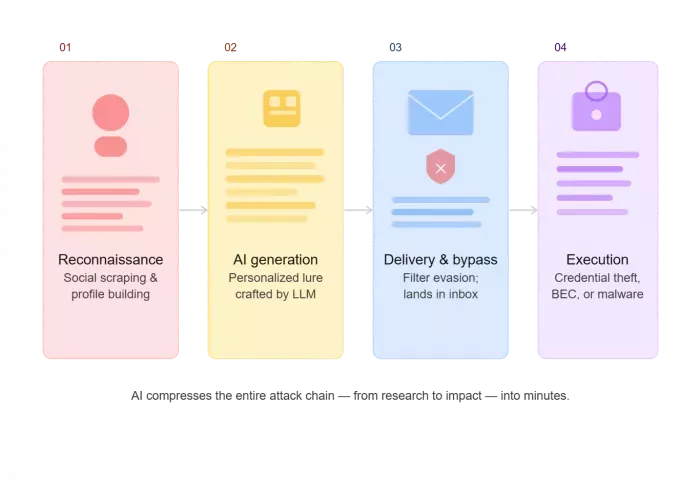
Threat actors moved quickly from experimenting with AI to actively deploying it. They’re using large language models (LLMs) to automate and optimize each phase of an attack:
● Writing Perfect Phishing Lures in Minutes: It used to take hours to research a target and write a convincing lie. Now, scammers use jailbroken LLMs to churn out hyper-personalized phishing emails in under five minutes.
● Scraping Social Media on Autopilot: Bad actors use machine learning scripts to crawl LinkedIn, X, and Facebook. They automatically harvest work histories, org charts, and personal hobbies to build highly accurate profiles for spear-phishing.
● Launching Millions of Attacks at Once: Instead of going after companies one by one, attackers use AI tools to distribute millions of unique messages simultaneously by tweaking the text and setup just enough to slip past broad blocklists.
● Deepfaking Execs for BEC: Business Email Compromise (BEC), fraud in which attackers impersonate executives or vendors to authorize financial transfers, isn’t just text anymore. Attackers are using AI voice cloning and fake video to pretend to be CEOs or vendors on phone calls and Zoom meetings, which tricks finance teams into sending massive wire transfers.
What Has Changed About the Cyber Threat Landscape?
Once threat actors began deploying AI, many of the security principles organizations had relied on for years became unreliable.
Old-School Filters Are Useless
Traditional email security gateways look for known bad patterns, specific text strings, or flagged sender reputations. Because AI can generate a unique email body, subject line, and backend setup for every single attack, it bypasses standard pattern-recognition filters entirely.
No More Bad Grammar Red Flags
For a long time, security training taught employees to look for broken English, typos, and weird phrasing to spot a scam. AI killed that red flag. Now, attackers can generate flawless corporate prose in almost any language, which perfectly mimics the tone of a professional business.
The Rise of QR Code Phishing (Quishing)
Quishing (QR code phishing) is an attack in which malicious links are embedded inside AI-generated QR codes buried in image attachments. Since normal filters scan for text and usually ignore image attachments, these “quishing” emails bypass security layers completely and land right in users’ inboxes.
Voice Cloning at Scale
Voice cloning tech has made phone-based social engineering incredibly easy. By grabbing just a few seconds of an executive’s voice from an online interview or a social media clip, scammers can create a highly realistic voice clone to trick internal staff over the phone.
Why Is Email Still the #1 Attack Vector?
Even with Slack, Teams, and everything else we use to communicate, email is still the number one target. Security research from the Cybersecurity and Infrastructure Security Agency (CISA) shows that over 90% of cyberattacks still start with a single phishing email.
AI makes this problem way worse because it makes fake emails look completely legitimate. When an email has perfect grammar, references your actual ongoing projects, and sounds exactly like your coworker, even the most tech-savvy employees can get fooled.
On top of that, it’s a numbers game. AI allows threat groups to scale their operations exponentially and flood corporate networks with a volume of phishing emails that leaves IT departments completely overwhelmed.
How AI Is Also Being Used to Defend
Defenders are also leveraging AI, and the tools are maturing quickly. While AI gives attackers an edge, it’s also giving defense teams the capability they need to fight back. Modern cybersecurity relies on machine learning to keep up with the speed and scale of these new threats.
Behavioral Analysis over Checklists
Traditional filters fail because they’re looking for known bad things. Defensive AI succeeds because it looks for weird things. Modern behavioral tools map out what “normal” looks like for your company, your usual login spots, who you talk to, and the words you use, and instantly flag anomalies that point to an attack. This is exactly how a modern DMARC report analyzer works. Instead of forcing you to read thousands of lines of raw XML data, it automatically scans global mail flows in real time and instantly flags authentication anomalies and unauthorized servers trying to use your name.
Real-Time Threat Intelligence
Machine learning models scan massive amounts of global internet traffic in real time. This helps security systems spot brand-new attack campaigns, newly registered malicious domains, and shifting hacker tactics across the web before they even reach your company’s network.
Automated Authentication Clean-up
AI is great at sorting through massive piles of data. In email security, machine learning handles the heavy lifting by pairing an automated DMARC AI assistant with your reporting data. By tracking sending sources across the globe, these tools immediately flag configuration errors and domain spoofing attempts without requiring manual human oversight.
ML-Based Spam and Phishing Filters
At the inbox and gateway level, machine learning models continuously retrain on emerging attack patterns to filter out threats that signature-based tools miss. Unlike static rule sets, these models adapt in near real time, which makes them significantly more effective against AI-generated phishing campaigns that vary with every send.
How Can Organizations Defend Against AI Cyber Threats?
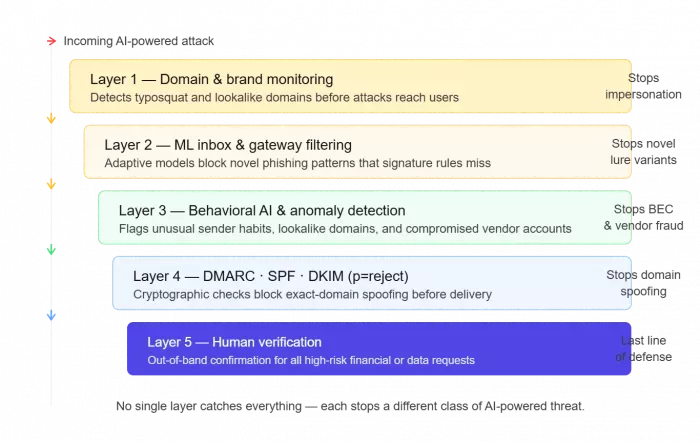
Fighting AI-driven threats means you have to stop trying to guess if an email looks fake and start verifying identities structurally. You can’t just expect your team to spot every smart lie; you need to put technical blocks in place that stop hackers from pretending to be you.
1. Lock Down DMARC to Strict Enforcement (p=reject)
The most direct technical control for stopping someone from faking your exact email domain is implementing Domain-based Message Authentication, Reporting, and Conformance (DMARC). You need to align your SPF (Sender Policy Framework) and DKIM (DomainKeys Identified Mail) protocols, and move your DMARC policy past p=none to full enforcement (p=reject). This tells receiving servers to drop unauthorized emails using your brand name before they ever hit anyone’s inbox.
2. Layer on Behavioral Detection
While DMARC stops exact-domain spoofing, it can’t stop a hacker from buying a lookalike domain (typosquatting) or hacking a vendor’s actual account. That’s why you need to layer AI-driven behavioral detection tools on top of your authentication. These systems look at headers, sender habits, and the context of the message to catch the stuff that basic checks miss.
3. Set Up a “Double-Check” Rule for Money and Data
If you’re wondering how to stop phishing emails, you need to understand that technology can’t fix everything. You need to update your internal playbook to require a secondary verification channel for high-risk tasks. If an email or phone call asks for a wire transfer, a change to vendor bank details, or sensitive employee data, staff must confirm it via a different method, like calling a known number or asking on internal chat, no matter how real the request seems.
4. Watch Your Domain Like a Hawk
Scammers love to register domains that look almost identical to yours to target your clients and team. Using continuous monitoring tools to watch for lookalike domains allows your security team to spot and disrupt impersonation campaigns before they cause damage.
5. Assume Every Email Could Be AI-Generated
The most important mindset shift is to stop relying on instinct and start building verification into processes. A perfectly written email from your CEO is no longer evidence that it’s real. Organizations that treat every sensitive request, financial approvals, data access, and credential changes as potentially AI-generated are the ones that maintain resilience even when other defenses are bypassed.
Conclusion
AI-powered attacks are not a passing trend, and threat actors will continue to make their techniques better and better. You can no longer rely on an employee to spot a phishing email because of a typo. To keep your organization secure, you need to move from reactive filters to structural security. Lock down your email authentication with a solid DMARC policy, layer AI-driven defenses on top to catch anomalous patterns, and make sure your team always has a secondary way to verify high-risk requests. AI can be used against you, but it can also be used for you, by yourself!
Frequently Asked Questions
How is AI being used in cyberattacks?
Hackers are using AI to automate target research, write flawless, personalized phishing emails, create malicious code, and launch massive campaigns simultaneously. They’re also using voice cloning and deepfake video to impersonate executives over the phone or on video calls.
Can AI-powered phishing emails bypass security filters?
Yes, easily. Old-school security gateways look for specific bad text or known malicious links. Because generative AI creates a completely unique email and new backend infrastructure for every attack, it passes right through standard content filters.
What is the best defense against AI cyber threats?
The best approach is a layered defense. You want structural identity checks like DMARC to stop domain spoofing, combined with AI-powered behavioral tools to catch weird email patterns, and strict internal policies that require double-checking sensitive requests.
How does DMARC help protect against AI phishing?
DMARC acts as a digital ID check. No matter how perfect or convincing an AI-written email is, it won’t pass cryptographic authentication checks if it's trying to spoof your exact domain. A strict p=reject policy tells mail servers to instantly block those fakes.
What is quishing, and why is it harder to detect?
Quishing or QR code phishing is an attack in which a malicious URL is encoded inside a QR code image rather than a text link. Because most email security gateways scan text and URLs but not image contents, these attacks bypass standard filters entirely. AI makes quishing more scalable by automating the generation of unique QR codes at volume.

Comments