TheSindi Com Review: Real Site vs Copies, Is It Legit? (2026)

Rajat Chauhan

Table of Contents
- TheSindi com at a glance
- Key takeaways
- What is TheSindi com?
- Which TheSindi site is the real one?
- Who owns TheSindi com, and who writes it?
- What does TheSindi com publish, and how good is it?
- How fast and usable is the site?
- How many people search for TheSindi com?
- Is TheSindi com legit or a content farm?
- TheSindi com vs specialist sites
- Does TheSindi com accept guest posts?
- Pros and cons
- Who should use TheSindi com, and how to use it safely
- How I checked
- Frequently asked questions about TheSindi com
- Final verdict
TheSindi com (thesindi.com) is a free, multi-topic blog founded in 2023 that publishes beginner-level articles on technology, finance, business, health, law, travel and more. It is a real, working website and not a scam. It also names no owner or editor, its articles run under a pen name, and at least three unrelated sites now copy its name. The official address is www.thesindi.com.
I first reviewed the site in June 2026 and re-checked everything on 30 September 2026: the domain records, the About and policy pages, the bylines, and the look-alike domains that now appear above the real site when you search its name. This review covers what TheSindi com is, which site is the genuine one, who is behind it, how good the content is, and when you should and should not rely on it.
TheSindi com at a glance
| Official address | www.thesindi.com (thesindi.com redirects to it) |
| What it is | A free, multi-topic blog. Articles open without an account or a paywall. |
| Founded | 2023, according to its About page. The domain was registered on 18 March 2023. |
| Domain registered until | 18 March 2034 |
| Registrar | Wild West Domains, LLC. The public registry record does not show an owner. |
| Platform | WordPress |
| Categories | Technology, Gaming, Finance, Business, Education, Health, Lifestyle, Law, Travel |
| Named owner or editor | None published |
| Byline on recent posts | "Roland", which links to the author address /author/brijesh/ |
| Contact | Email only |
| Policy pages | About, Editorial Policy, Disclaimer, Privacy Policy, Terms and Conditions |
| Look-alike sites | the-sindi.com, the-sindi.org and thesindicom.us. None is the same site. |
| Searches for the name | About 221,000 a month worldwide, 79% of them from the United States (Ahrefs, September 2026) |
| Last checked | 30 September 2026 |
Key takeaways
- The real site is www.thesindi.com, with no hyphen. It has been registered since March 2023.
- TheSindi com is legitimate in the plain sense: it is a functioning publication with policy pages and a domain paid up to 2034. It is not an authority on any one subject.
- Three look-alike sites use its name. Two of them were registered in June and August 2026, and one led its homepage with online poker and casino posts when I checked.
- Articles are credited to "Roland", but the author link points to an account called "brijesh". No person is named anywhere as owner or editor.
- It is fine for a quick, plain-language introduction to a topic. For money, health or legal decisions, confirm what you read with a specialist source.
What is TheSindi com?
TheSindi com is a general-interest website that publishes short explanatory articles across many unrelated subjects. Its About page describes it this way: "Founded in 2023, Thesindi.com is an independent digital publication dedicated to creating informative, well-structured, and reader-focused content across a broad spectrum of topics."

The About page on www.thesindi.com, captured on 30 September 2026. It gives 2023 as the founding year and names no founder, editor or company.
In practice that means short articles, around a thousand words or fewer, on subjects as far apart as prediction markets, contractor insurance, venture debt and addiction treatment programs. On 30 September 2026 the navigation listed nine categories: Technology, Gaming, Finance, Business, Education, Health, Lifestyle, Law and Travel. When I first reviewed the site in June 2026 the menu showed seven, so Gaming and Travel have been added since. A page the site published about itself on 6 August 2026 adds Home Improvement and Real Estate to the list.
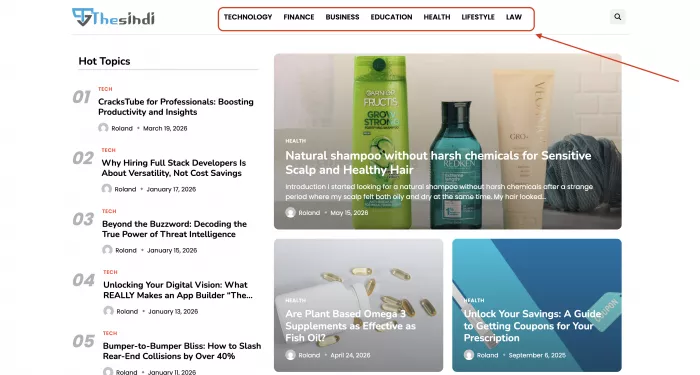
The TheSindi.com homepage as captured for my June 2026 review. The red box, added for emphasis, marks the seven categories the menu showed at the time. Every post in view is credited to "Roland".
You do not need an account to read anything. When I tested the site, its pages carried display adverts, which is how it appears to pay its way.
Which TheSindi site is the real one?
This is the question most people searching "thesindi com" actually have, because the search results are crowded with near-identical names. In the results Ahrefs recorded for "thesindi com" on 25 September 2026, the first result was the-sindi.org, the third was a page on the-sindi.com, and thesindi.com itself was not in the top ten.
I looked up the public registration record of each domain and opened each site on 30 September 2026. This is what I found.
| Domain | Registered | What is on it | The real TheSindi? |
|---|---|---|---|
| www.thesindi.com | 18 March 2023 | The original publication this review is about. | Yes |
| the-sindi.com | 29 June 2026 | A blog titled "TheSindi Com | Technology, Business & Digital Knowledge". Its homepage linked to posts on bed bug treatment and a football live-betting strategy. Its contact page gives an email address at a different domain, rankenginesmedia.com. | No |
| the-sindi.org | 30 August 2026 | A blog titled "TheSindi com: Trusted Hub for Tech, Business & Digital Knowledge". Its homepage led with online poker and casino posts dated 19 September 2026. | No |
| thesindicom.us | Not shown in the lookup I ran | A site titled "TheSindi Com | Trusted Information & Expert Resources". Its contact page invites content submissions to a Gmail address. | No |
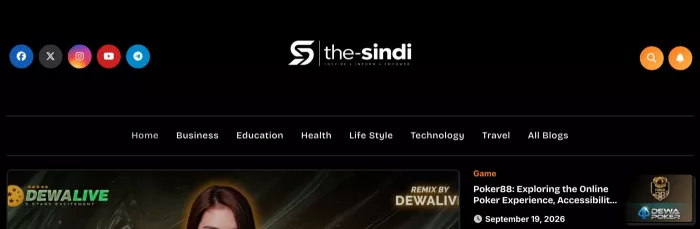
The homepage of the-sindi.org, captured on 30 September 2026. This is not thesindi.com. Its lead posts that day were about online poker and casino brands.
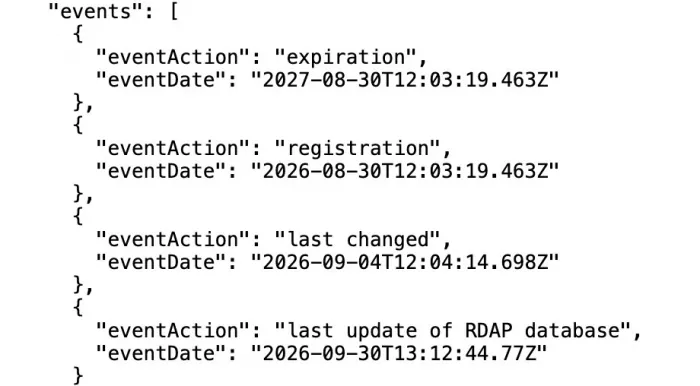
The registry record for the-sindi.org, retrieved from rdap.org on 30 September 2026. The domain was registered on 30 August 2026, more than three years after thesindi.com.
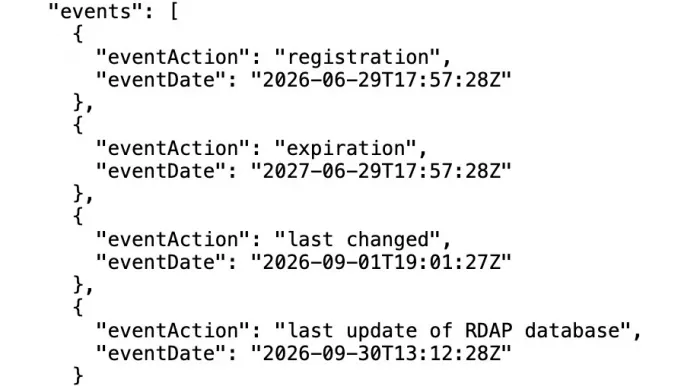
The registry record for the-sindi.com, retrieved from rdap.org on 30 September 2026. The hyphenated domain was registered on 29 June 2026.
None of the three homepages links to thesindi.com, and I found nothing that connects them to it. The two hyphenated domains were registered in mid-2026, more than three years after the original, and through a different registrar.
To be sure you are on the real site, check three things. The address has no hyphen and ends in .com. The About page says the publication was founded in 2023. The menu shows the nine categories listed above, with no gambling content on the homepage.
Who owns TheSindi com, and who writes it?
Nobody is named. The registry record shows that thesindi.com was registered on 18 March 2023 through Wild West Domains, LLC, runs on Cloudflare name servers, and is paid up until 18 March 2034. A registration that runs to 2034 suggests the owner intends to keep the site, which is a better sign than the one-year registrations on the look-alikes. The record does not show who that owner is.
The About page does not fill the gap. It says the site is "managed by an independent editorial team supported by experienced in-house writers" and names no founder, editor or company. The Contact page offers one email address and nothing else.
The byline that points to a different name
When I first reviewed the site in June 2026, I noticed something in how articles are credited, and it is still there.
The mismatch: Articles are credited on the page to an author called "Roland". Click that name and the address you land on is
https://www.thesindi.com/author/brijesh/. The page at that address is headed "Author: Roland".
On 30 September 2026 I confirmed this on three recent posts, dated 11 August, 25 August and 15 September 2026, covering India's stock market, contractor insurance and prediction markets. All three say "by Roland" and all three link to the "brijesh" address.

The page at www.thesindi.com/author/brijesh/, captured on 30 September 2026. The address says "brijesh". The heading and the byline say "Roland".
The likeliest explanation is an ordinary one. A single WordPress account, created under the name "brijesh", uploads the articles, and its public display name has been set to "Roland". That is common on sites that publish work from several outside writers under one login.
It does not make the articles wrong. It does mean you are not reading a named specialist who answers for what is written. On a site that publishes finance, health and legal topics, that matters.
Two other profiles rank for the site's name: a Quora space called "thesindi" and a SlideShare profile under the name "Nolan Parker, Blogger at Thesindi". I could not confirm who runs either.
What does TheSindi com publish, and how good is it?
To judge the writing itself, I read two articles from different sections line by line during my June 2026 review.
Case study A: a personal finance guide
The first was a guide to credit card basics and saving, the kind of topic where a mistake costs the reader money.
What worked: The structure was tidy. A short introduction, clear subheadings, and neat definitions of interest rates and grace periods. Nothing I read was factually wrong.
What was missing: Any sign that the writer had been through it. There was no account of an unexpected fee, no description of dealing with a bank's phone menu or its customer service, no opinion. It read like a textbook chapter.
Case study B: a fashion and lifestyle piece
The second was an introduction to putting a wardrobe together.
What worked: It was readable, well paced and illustrated with sharp photographs.
What was missing: Every photograph was stock. An article about how clothes look and wear is more useful with a real photo of a real garment, even an imperfect one. The advice repeated principles you can find on many other blogs and added no test or observation of its own.
Both pieces were accurate, clear and generic. That is the pattern across the site: good for a first explanation, thin on experience and evidence.
How fast and usable is the site?
I tested TheSindi com in June 2026 on an older phone over an ordinary 4G connection in New Delhi, which is a harder test than a new phone on office Wi-Fi.
Speed: It is quick. In laboratory speed tests at the time, the mobile score sat consistently in the high 80s, better than many large news sites weighed down by tracking scripts. Text appears almost at once.
The ad problem: The page text loads first and the banner advert at the top loads a moment later, pushing everything down. Moving from the Finance section to a Lifestyle headline, that shift made me tap an advert instead of the article I was aiming for. It is a small thing, but it is the kind of friction that comes from putting advertising first.
How many people search for TheSindi com?
A lot, for a site this size. Ahrefs first recorded searches for the name on 17 March 2025, and its September 2026 figures show about 221,000 searches a month worldwide for "thesindi com".
| Country | Monthly searches for "thesindi com" | Share |
|---|---|---|
| United States | 176,000 | 79% |
| India | 32,000 | 14% |
| Russia | 1,700 | Under 1% |
| Saudi Arabia | 1,000 | Under 1% |
| Vietnam | 600 | Under 1% |
| Turkey | 600 | Under 1% |
These are searches for the name, not visits to the site. They still explain two things: why copies of the name appeared in mid-2026, and why so many near-identical "TheSindi com review" pages now exist.
Is TheSindi com legit or a content farm?
Signs that it is legitimate
- The domain has been registered since March 2023 and is paid up until 2034.
- It publishes a full set of policy pages, including an editorial policy that says it separates editorial decisions from commercial interests.
- It is free to read, asks for no account, and I saw no downloads or login prompts while reading.
- The writing is clean and correctly structured, and the site is fast.
Reasons to be careful
- No owner, editor or company is named anywhere.
- Articles run under a pen name that does not match the account behind it.
- It covers finance, health and law without named, qualified authors.
- It spreads across many unrelated subjects instead of building depth in one.
- A listing offering guest posts on the site appears on an outside marketplace, so some articles may be contributed by third parties.
"Content farm" usually means scraped or machine-spun text with broken grammar, published only to catch ad clicks. TheSindi com is not that. It is polished and organised. The fairer description is an entry-level generalist explainer site: it finds the everyday questions people search for and answers them in plain language. It is not a scam, and it is not a source to settle an important decision on.
TheSindi com vs specialist sites
| What you are comparing | Specialist sites (for example NerdWallet, TechCrunch) | Generalist sites (for example TheSindi com) |
|---|---|---|
| Main purpose | Detailed, expert coverage of one field. | Clear, short introductions to everyday topics. |
| Authors | Named writers with a checkable professional history. | General bylines, often pen names. |
| Sources | Links to studies, filings and regulators. | Fewer primary sources. |
| Depth | Written for people who need the detail. | Written for beginners. |
I have run the same checks on other sites that people search for by name, including NewsExamine and Techlogiest.
Does TheSindi com accept guest posts?
The site does not advertise it. On 30 September 2026 I found no "Write for Us" page linked from the homepage, and the only way to reach the team is the email address on the Contact page.
Outside the site it is a different picture. A listing titled "Guest Post On thesindi" on the marketplace guestpostnow.com appeared on the first page of results for the site's name in Ahrefs' snapshot of 25 September 2026. So contributed articles are probably part of what the site publishes. When an article there recommends a product or a service, read it with that in mind.
One warning for anyone buying a placement: make sure the offer is for thesindi.com and not one of the hyphenated look-alikes.
Pros and cons
Pros
- Plain language. It avoids jargon, which makes it a good first stop for a beginner.
- Fast pages. It loads quickly on mobile data.
- Easy to scan. Articles are broken into short, logical sections.
- Free and open. No account and no paywall.
Cons
- Surface-level. If you already know the basics of a topic, you will learn little.
- Unclear authorship. The "Roland" byline and the "brijesh" author address do not match, and nobody is named as responsible.
- Thin evidence. Little first-hand testing, and few links to primary sources on topics that need them.
- Advert layout shift. The top banner can move the page as it loads.
Who should use TheSindi com, and how to use it safely
- Use it when you want a quick, readable overview of an unfamiliar subject.
- Check the address first. It should be www.thesindi.com, with no hyphen.
- Verify before you act. For anything involving money, health or the law, confirm the key facts with a regulator, an official body or a named specialist.
- Look at the date. Rates, rules and prices change, and a general site may not update old posts.
- Share nothing you do not need to. Reading requires no sign-up. If any site using this name asks for a password, card details or a download, leave.
How I checked
In June 2026 I spent a week using the site, ran speed tests on it from a phone, and read two articles closely. On 30 September 2026 I went back and re-checked the facts that can change:
- The public registration records for thesindi.com, the-sindi.com and the-sindi.org. Anyone can repeat this with ICANN's lookup tool.
- The site's About page, Editorial Policy and Contact page.
- The bylines and author links on three recent posts.
- The homepages and contact pages of the three look-alike sites.
- Search data and the search results for "thesindi com" from Ahrefs, dated 25 September 2026.
Frequently asked questions about TheSindi com
Is TheSindi com safe to visit?
Yes, the real site at www.thesindi.com is safe to read. It uses HTTPS, needs no account, and I saw no downloads or login prompts. It does carry display adverts, so take the usual care about what you tap.
Is TheSindi com a scam?
No. It is a working blog that has existed since 2023 and publishes ordinary informational articles. The caution is about how much weight to give its advice, not about fraud.
Who owns TheSindi com?
That is not public. The domain record shows the registrar, Wild West Domains, LLC, and not the owner. The About page names no founder, editor or company.
Are the-sindi.com and the-sindi.org the same as thesindi.com?
No. thesindi.com was registered on 18 March 2023. the-sindi.com was registered on 29 June 2026 and the-sindi.org on 30 August 2026, and neither links to the original. thesindicom.us is a third separate site. The real one has no hyphen.
Is TheSindi com free, and do I need an account?
It is free and you do not need an account to read any article.
Can I trust TheSindi com for finance or health advice?
Use it as a starting point only. The articles are clear, but they are not written by named, qualified experts. Confirm anything important with an official or specialist source before you act on it.
Does TheSindi com accept guest posts?
It does not advertise a contributor page, but it is listed on at least one guest-post marketplace, so third-party articles are likely part of its content.
Why does TheSindi com appear for so many unrelated searches?
Because it publishes across nine or more unrelated categories. A site that writes about loans, travel, law and gaming will show up for searches on all of them.
Final verdict
TheSindi com is a fast, readable, legitimate general-interest blog. If you land on it looking for a quick definition or a plain summary, it will usually give you one.
Know its limits. Nobody is named as responsible for it, its articles run under a pen name, and it covers subjects where a named expert matters. And make sure you are on the right site: www.thesindi.com, not one of the hyphenated copies that appeared in 2026.
Read it for the first five minutes of learning about something. Go to a specialist for the decision.

Comments