Vapi AI Review 2026: In-Depth Analysis, Honest User Feedback, Pros & Cons

Trevor Hall
Voice AI technology has moved from experimental to essential. Businesses across industries now seek tools that can automate customer calls, handle support queries, and improve engagement without adding staff. Vapi AI promises exactly that: a flexible, developer-centric platform for building advanced voice agents.
But does it deliver in real use? In this detailed review, we cover what Vapi AI really offers, how it works, real user experiences, where it shines, and where it struggles.
What Is Vapi AI and Who Is It For?
Vapi AI is a voice agent infrastructure platform designed to help developers build AI-powered phone systems that can interact with customers using speech-to-text, large language models (LLMs), and text-to-speech. Unlike simple drag-and-drop voice bots, Vapi provides APIs and modular components that support real production use cases where integration with business logic and external data systems is critical.
This makes Vapi particularly suitable for:
- Technical teams building custom voice automation
- Enterprises integrating AI voice agents into existing systems
- AI automation agencies
- Developers seeking full control over voice workflows
- Vapi is not aimed primarily at non-technical users looking for plug-and-play solutions.
How Vapi AI Works: A Simplified Workflow
Here’s an overview of how a typical Vapi AI voice agent functions:
- A user calls a phone number linked to the Vapi system.
- Speech is converted into text with an STT (speech-to-text) provider.
- An AI model generates responses based on the text.
- Responses are converted back to voice using TTS (text-to-speech).
- APIs connect the interaction with backend systems like CRMs, databases, or workflows.
- The agent conveys responses to the caller in real time.
- That modular API-driven approach allows for deep customization, but it requires technical expertise to configure and maintain.
Key Features That Make Vapi AI Stand Out
Deep Integration and API-First Design
Vapi offers extensive APIs that allow developers to connect voice agents with internal data sources, business logic, and existing systems. This enables advanced automation that goes beyond canned responses.
Flexible AI Stack
Users can choose different providers for speech recognition, natural language processing, and voice output, optimizing for cost, quality, or language support.
Real-Time Call Orchestration
The platform supports real-time voice streaming, enabling conversations that feel more natural and responsive during live calls.
Multilingual Support
Vapi can work with various language and voice providers, helping organizations reach diverse audiences.
Monitoring and Logging
Built-in logging and event tracking help teams measure performance, debug issues, and refine voice agent behavior over time.
Pros and Cons Based on Expert Reviews
Core Strengths
- Highly flexible API infrastructure for deep customization.
- Real-time conversations with low latency under typical configurations.
- Support for multiple languages and voice providers.
- Designed for high-volume and enterprise-scale deployments.
- Active development with frequent feature updates.
Common Limitations
- Significant learning curve for non-technical users.
- Costs can rise due to separate charges for LLM, STT, TTS, and telephony.
- Limited native no-code tools compared to alternatives.
- Support experiences vary widely.
- Phone number provisioning outside major regions may require workarounds.
Real User Reviews: What People Are Saying
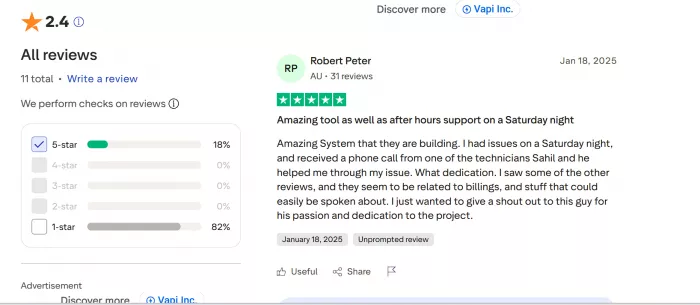
Below is a summary of actual user feedback from Reddit and Trustpilot, organized into positive and negative impressions to give a balanced view.
Positive User Feedback
- Developer Flexibility and Customization
Many users appreciate that Vapi allows them to build highly customized voice agents with control over models, routing, and integration. This level of flexibility is rare in voice AI tools and valuable for complex use cases. - Voice Quality and Responsiveness
Some reviewers note Vapi can deliver convincing voice interactions, especially when paired with high-quality providers, making conversations seem more natural. - Faster Integration than Expected
A subset of developers reports being able to prototype and test voice agents more quickly than anticipated, particularly when APIs and documentation are familiar. - Scalability for Enterprise Projects
Users implementing Vapi in larger environments (tens of thousands of calls) observe that the platform handles load well, indicating robust infrastructure for substantial projects.
- Continual Development and Improvements
A Reddit thread indicates ongoing platform improvements and positive sentiment from users who automate testing and processes around Vapi, suggesting active community participation and evolution.
Negative User Feedback
- Poor or Slow Customer Support
Multiple Trustpilot reviews and individual Reddit posts highlight experiences where support was either extremely slow or unresponsive, particularly when dealing with urgent production issues. - Unreliable Billing and Refund Issues
Some users report difficulties getting refunds or clear billing explanations, which has led to frustration, especially after spending significant amounts. - Latency and Real-World Voice Delays
Users working with real phone calls note noticeable lag between speech and response, making conversations feel less fluid than expected in practice.
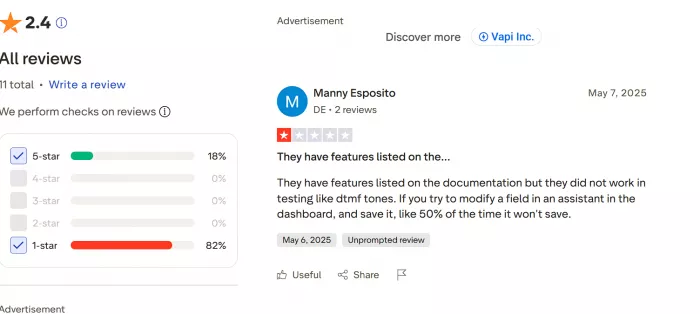
- Inconsistent Call Behavior in Complex Scenarios
Several reports mention issues like incorrect voicemail detection, unexpected behavior in call flows, and voice inconsistency. - Perception of Scalability Issues for Sales Outreach
In cold calling scenarios, some community members feel that Vapi responses do not match real sales agent performance and see lower conversion effectiveness compared to other tools.
Pricing Reality: What You Should Know
Vapi’s pricing structure uses a usage-based model, typically charging:
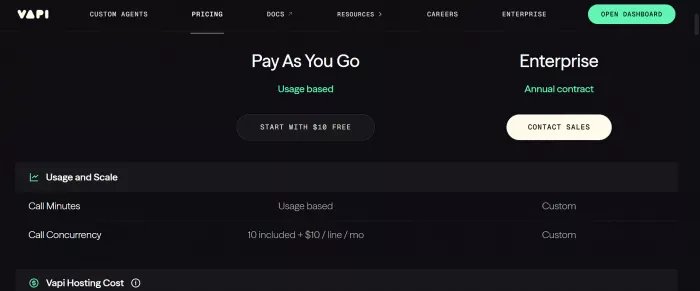
- A base platform fee per minute,
- Additional charges for STT, TTS, LLM consumption, and telephony services.
- This layered billing can make total costs higher than initial advertised rates, especially for high-volume use cases. Businesses must budget carefully and monitor usage to keep costs predictable.
Final Verdict: Is Vapi AI the Right Choice?
Vapi AI is a powerful platform for teams that need deep voice agent customization and integration control. Its API-first architecture and flexibility make it a compelling choice for developers and enterprises with complex automation needs.
However, businesses seeking plug-and-play simplicity, predictable pricing, and strong support structures may find Vapi challenging without dedicated development resources.
Ultimately, Vapi AI is best suited for:
- Technical teams with engineering support
- High-volume environments with voice integration demands
- Organizations willing to manage costs and infrastructure themselves
It may be less suited for:
- Non-technical small business owners
- Teams seeking fully managed solutions
- Users wanting simple voice chatbot builders

Comments