UGE Schedule Source: A Workforce System Built for High-Risk Environments

Trevor Hall
Table of Contents
- What UGE Schedule Source Actually Is
- A Platform Shaped by Its Origins
- Where TeamWork Performs Exceptionally Well
- The Trade-Off: Usability vs Control
- Employee Autonomy Within Hard Rules
- Why TeamWork Is Not for Everyone
- Market Position and Longevity
- Pricing Reflects the Target Audience
- Why Organizations Continue Using It
- Final Assessment
Most workforce management tools are designed to optimize convenience. They focus on usability, speed, and visual clarity. UGE Schedule Source, formally known as TeamWork by ScheduleSource, was built with a very different priority: operational reliability in environments where mistakes carry consequences.
This distinction explains nearly everything about the platform. Its design, its learning curve, and even its criticisms all stem from the same foundational choice. TeamWork is not meant to impress casual users. It is meant to function under pressure.
What UGE Schedule Source Actually Is

UGE Schedule Source is not a standalone product or company. It refers to an organization-specific deployment of the TeamWork workforce management platform, accessed through subdomains such as uge.schedulesource.net.
The underlying software is developed and maintained by ScheduleSource, Inc., a Colorado-based company that has specialized in workforce scheduling since 1999. These subdomains are typically used by large institutions such as universities, healthcare systems, airlines, and government contractors, each with its own customized rules and configurations.
This matters because TeamWork is not positioned as a generic sign-up SaaS product. It operates more like infrastructure than an app.
A Platform Shaped by Its Origins
ScheduleSource launched TeamWork as one of the earliest web-based automated scheduling systems. At the time, most organizations were still managing labor through paper schedules, spreadsheets, or static databases.
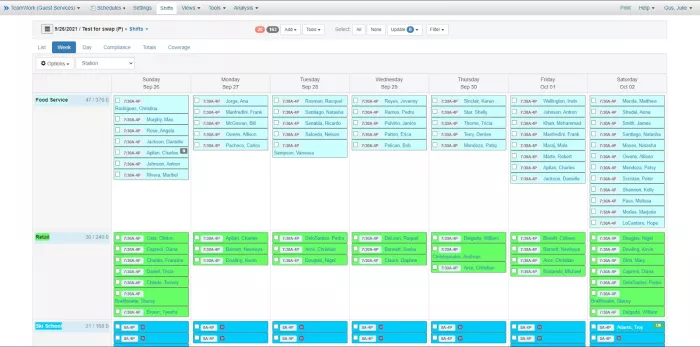
From the beginning, the platform emphasized automation, rule enforcement, and auditability rather than visual design. Over time, new capabilities were layered on instead of replacing the original structure. This evolutionary approach explains both the system’s durability and its dated interface.
The result is software that can handle complex realities such as rotating shifts, skill-based assignments, regulatory compliance, and emergency scheduling without collapsing under scale.
Where TeamWork Performs Exceptionally Well
TeamWork excels in environments where workforce planning is constrained by overlapping rules and risks rather than simple availability.
| Area | How TeamWork Handles It | Why It Matters |
| Scheduling | Automated fill, swaps, trades, bidding | Reduces manual coordination |
| Compliance | Rule-based enforcement | Prevents illegal assignments |
| Scale | Hundreds to thousands of workers | Supports institutions |
| Reporting | Detailed labor analytics | Enables audits |
| Integration | Payroll, HR, SSO, APIs | Fits enterprise stacks |
This is why the platform remains common in universities managing thousands of student workers, healthcare departments coordinating licensed roles, and federal contractors operating across multiple states.
The Trade-Off: Usability vs Control
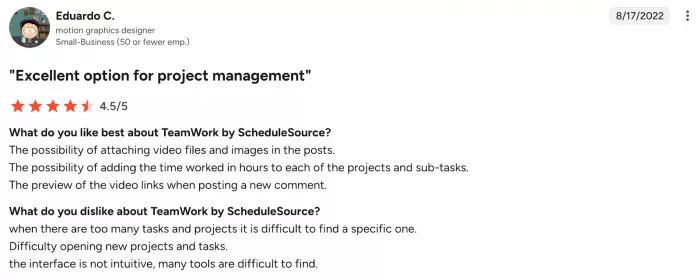
The most consistent criticism of TeamWork is its interface complexity. Users frequently describe it as unintuitive, especially during early adoption. Navigation relies heavily on lists and menus rather than visual calendars, and many features are buried behind configuration layers.
This is not accidental. The system assumes training and role-based access, not self-discovery. In return, it offers precise control over who can do what, when, and under which conditions.
The same trade-off appears in the mobile app. While it enables shift viewing and basic actions, reviews regularly mention instability, forced logouts, and missed shifts during high-traffic bidding windows.
Employee Autonomy Within Hard Rules

One of TeamWork’s defining strengths is how it decentralizes scheduling without losing oversight. Employees can manage availability, trade shifts, and participate in bidding processes directly, without involving supervisors in every change.
This approach delivers real efficiency gains. Organizations report dramatic reductions in administrative workload once employees are empowered to manage their schedules themselves.
However, this autonomy only works when the system is configured correctly. Poor setup or unclear permissions can quickly turn empowerment into frustration.
Why TeamWork Is Not for Everyone
TeamWork assumes that scheduling is a core operational function, not a side task. That assumption makes it a poor fit for organizations that only need basic coverage planning.
It struggles in environments where:
→ teams want minimal setup
→ leadership avoids training investment
→ existing tools already dominate workflows
Several enterprise reviewers note that TeamWork becomes excessive when only a small portion of its capabilities are used. In those cases, complexity outweighs value.
Market Position and Longevity
| Dimension | TeamWork | Typical Modern Tools |
| Primary goal | Compliance and reliability | Ease of use |
| Ideal users | Large regulated orgs | SMBs |
| Interface | Functional, dated | Polished |
| Learning curve | High | Low |
| Product age | 20+ years | Often under 10 |
This comparison explains why TeamWork occupies a stable but narrow niche. It does not compete on trendiness. It competes on trust.
Pricing Reflects the Target Audience

ScheduleSource does not publish standardized pricing. Cost is determined by workforce size, locations, integrations, compliance needs, and support requirements.
For large institutions, this model aligns with operational reality. For smaller teams, it often prevents adoption altogether.
Why Organizations Continue Using It
Despite interface complaints and mobile limitations, long-term customers remain loyal for one reason: risk mitigation.
TeamWork enforces rules consistently, records actions reliably, and holds up during audits. In industries where mistakes have legal or contractual consequences, that reliability outweighs convenience.
Managers may not enjoy using the system, but they trust it.
Final Assessment
UGE Schedule Source is not outdated software struggling to survive. It is purpose-built workforce infrastructure that prioritizes correctness over comfort.
It is a poor choice for teams seeking simplicity or speed. It is a strong choice for organizations where scheduling errors are unacceptable.
Judged as a modern app, it feels behind. Judged as a control system for complex labor environments, it remains quietly effective.
And that tension defines everything about TeamWork by ScheduleSource.

Comments