The AI Video Race Is Shifting From Better Clips to Better Control

Andrew Rackley
Table of Contents
- The finish line moved
- Nine shifts reshaping AI video
- From clips to continuous takes
- Audio becomes part of the experience
- Control and consistency become the real competition
- Seedance 2.5 vs MiniMax H3 vs Wan 3.0: Comparison
- What each model represents
- Seedance 2.5 — The controlled generation approach
- MiniMax H3 — The editable video approach
- Wan 3.0 — The production pipeline approach
- What creators should watch next
- Marketers
- Filmmakers
- Creators
- Why control may matter more than novelty
- Conclusion
For the last few years, the generative video race was defined by one question: which model could create the most realistic-looking clip?
Sharper textures, smoother motion and better physics dominated the competition. But as leading models started reaching similar levels of visual quality, the focus began changing.
The next battle is not only about creating a beautiful video. It is about giving creators more control over how that video is built, edited and reused.
Seedance 2.5 from ByteDance, MiniMax H3 from MiniMax and Wan 3.0 from Alibaba represent three different approaches to this new phase of AI video generation. One focuses on longer controlled sequences, another on editing flexibility, while the third explores broader creative workflows.
Rather than looking for a single winner, these three models show where AI video is heading next: from generating clips toward becoming a complete creative production system.
The finish line moved
AI video models have reached a stage where basic realism is no longer enough to separate one system from another.
Most advanced models can now create convincing environments, realistic characters and cinematic camera movements. The bigger challenge is maintaining consistency, following detailed instructions and allowing creators to make changes without restarting the entire generation process.
That shift explains why Seedance 2.5, MiniMax H3 and Wan 3.0 are competing on different ideas of control rather than only visual quality.
The future advantage will likely come from models that help creators complete projects faster, not just create impressive demonstrations.
Nine shifts reshaping AI video
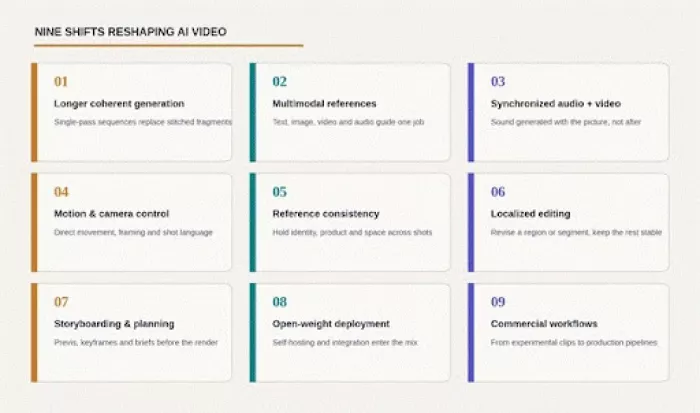
Nine changes are pulling the field from clip generation toward directable production. They do not arrive evenly, each model leads on some and lags on others, so the sections below walk them in clusters, using Seedance 2.5, MiniMax H3 and Wan 3.0 to show what each shift looks like in practice.
From clips to continuous takes
One of the biggest changes in AI video is the movement from isolated clips toward longer, more connected scenes.
Earlier systems often created short outputs that needed significant editing afterward. Newer models are improving their ability to maintain characters, environments and motion patterns across longer sequences.
Seedance 2.5: Building longer creative sequences
Seedance 2.5 represents the push toward more directed video generation. ByteDance’s model focuses on longer sequences, larger reference inputs and more control over how a scene develops.
For creators working on advertisements, cinematic shots or product storytelling, the advantage is not only generating a frame but maintaining the creative intention throughout the sequence.
The model reflects a broader industry shift: AI video is moving closer to a virtual production assistant rather than a simple text-to-video generator.
MiniMax H3: Editing becomes the focus
MiniMax H3 takes a different approach. Instead of focusing primarily on longer generation, it places more emphasis on editing and modification.
The idea is simple: creators do not always need a completely new video. They often need to adjust an existing one.
Changing elements, refining scenes and improving outputs through instructions could become one of the most important parts of future AI video workflows.
Wan 3.0: Expanding the creative workflow
Alibaba’s Wan 3.0 represents another direction: connecting AI video generation with broader creative inputs.
Instead of treating video as an isolated output, the model aims toward workflows where different types of creative material can influence the final result.
This approach reflects a future where AI video tools become part of larger production pipelines.
The creative brief is becoming larger
Modern AI video creation is becoming more multimodal.
Creators are no longer depending only on text prompts. Images, videos, references and other creative materials are increasingly becoming part of the generation process.
Seedance 2.5, MiniMax H3 and Wan 3.0 all represent this movement in different ways.
The importance of prompting is also changing. Instead of writing a single sentence and hoping for the best result, creators are moving toward a production-style approach involving references, planning and iteration.
Audio becomes part of the experience
Video generation is increasingly becoming connected with sound.
AI models are improving their ability to combine visuals with audio elements, creating workflows where creators do not need to treat sound as a completely separate stage.
However, generated audio still requires human review. Natural dialogue, timing and emotional delivery remain difficult challenges.
The technology improves speed, but professional results still depend on creative judgment.
Control and consistency become the real competition
The biggest challenge for AI video is no longer producing one impressive clip.
The challenge is producing the same quality repeatedly.
Brands need consistent products, characters and visual styles. Filmmakers need reliable scenes. Creators need tools that allow revisions without losing the original direction.
This is where the difference between Seedance 2.5, MiniMax H3 and Wan 3.0 becomes clearer.
Seedance focuses on directed generation.
MiniMax focuses on editable workflows.
Wan focuses on broader creative production..
Seedance 2.5 vs MiniMax H3 vs Wan 3.0: Comparison
| Category | Seedance 2.5 | MiniMax H3 | Wan 3.0 |
| Developer | ByteDance | MiniMax | Alibaba Tongyi Lab |
| Main approach | Controlled video generation | Editing-focused workflow | Broader creative production workflow |
| Core strength | Longer sequences and creative direction | Instruction-based editing | Expanding inputs and workflow integration |
| Best suited for | Cinematic scenes, advertisements, storytelling | Content refinement and flexible editing | Marketing, creative production and experimentation |
| Creative focus | Building the shot | Improving the shot | Connecting the whole workflow |
What each model represents
Seedance 2.5 — The controlled generation approach
Seedance 2.5 represents the idea that AI video should behave more like directing a scene.
Its biggest contribution is pushing creators toward longer, more structured outputs where references and creative decisions play a larger role.
MiniMax H3 — The editable video approach
MiniMax H3 highlights a future where AI-generated videos are not final outputs but starting points.
The ability to refine and modify content through instructions could become one of the most valuable features for everyday creators.
Wan 3.0 — The production pipeline approach
Wan 3.0 represents the idea that AI video will become connected with wider creative workflows.
The future may not involve generating videos from scratch every time, but transforming existing ideas and materials into finished visual content.
What creators should watch next
Marketers
For brands, the biggest opportunity is producing more content while maintaining consistency.
AI video tools could help create campaign variations, product demonstrations and social media content faster, but quality control and rights management will remain important.
Filmmakers
AI video is likely to become increasingly useful for concept development, visual planning and testing creative ideas before production begins.
The technology may reduce preparation time while still leaving storytelling decisions in human hands.
Creators
The creators who benefit most will likely be those who understand references, editing and visual direction.
The future advantage will not come only from writing better prompts but from managing the complete creative process.
Why control may matter more than novelty
The first generation of AI video was built around surprise.
A generated clip that looked impossible was enough to attract attention.
The next generation will be judged differently.
The winning systems will be the ones that help creators maintain consistency, make changes quickly and produce reliable results.
Seedance 2.5, MiniMax H3 and Wan 3.0 show three different paths toward that future. The AI video race is no longer only about creating something impressive once. It is about giving creators the power to create, refine and repeat.
Conclusion
The competition between Seedance 2.5, MiniMax H3 and Wan 3.0 shows that AI video is entering a new stage. The industry is moving beyond the race for the most realistic single clip and toward building systems that can support complete creative workflows.
Seedance 2.5 represents the push toward longer, more directed video creation. MiniMax H3 highlights the growing importance of editing and refinement. Wan 3.0 explores how AI video can become part of a broader production process by connecting more creative inputs with generation.
No single model defines the future of AI video on its own. The next winners will likely be the tools that give creators the greatest control, consistency and flexibility throughout the production journey.
As AI video becomes more integrated into advertising, filmmaking and everyday content creation, the biggest shift will not be that machines can create videos. It will be that creators can turn ideas into finished visual stories faster, with more precision and fewer limitations.

Comments