Scoopz: The New Real-Life Video Platform You Need To Know About

Ruan Cleiton

What Makes Scoopz Different?
Scoopz positions itself as a short‑video platform built around unscripted, everyday moments instead of heavily edited trends. The feed is packed with real accidents, street clips, daily routines, local events, and personal vlogs, more like scrolling through a live video diary than a global talent stage.
A big part of its identity is the promise of fewer ads and more authenticity. Many users describe Scoopz as a place where normal people share what’s actually happening in their lives, without the pressure of filters, transitions, or perfect lip‑syncs. Creators can hit records quickly, trim a bit, add a title, choose a cover, and post—no studio setup or editing suite required.
How the App Actually Works
Scoopz blends standard short-video mechanics with a community-driven discovery model:
Short, real-life clips on everyday situations, commutes, mishaps, or local events.
Simple creation tools intentionally exclude complex effects and AR filters to lower the barrier for new creators.
'Circles' (topic clusters) and optional location tags make the feed locally relevant.
Core social features: likes, comments, follows, shares, DMs, and a basic creator dashboard.
Data Check: Ratings and Sentiment
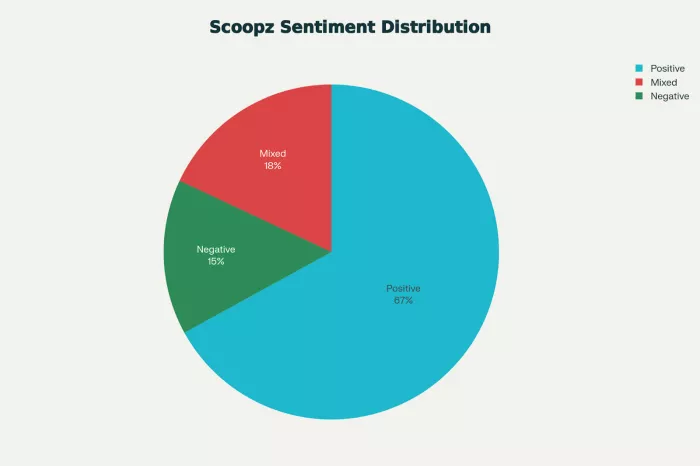
To make that breakdown immediately understandable, use the “Overall sentiment distribution for Scoopz reviews” pie chart. It’s a clean way to show that the majority sentiment is still positive, but that a meaningful slice of users and experts are mixed or outright negative.
Feature Deep‑Dive with Data: Scoopz vs TikTok vs Instagram Reels
| Feature / Aspect | Scoopz | TikTok | Instagram Reels |
| Content focus | Real‑life, unscripted, low‑ad videos | Viral trends, music, challenges, memes | Lifestyle, aesthetics, creator branding |
| Editing tools | Minimal trimming, titles, simple covers | Rich filters, effects, transitions, sounds | Strong filters, transitions, AR effects |
| Community size | Niche, fast‑growing since ~2024 | Huge global audience | Huge, tied to Instagram base |
| Feed structure | For You‑style feed plus topic/local Circles | For You and Following feeds | Reels tab plus Explore integration |
| Ads in main feed | Very light / near ad‑free feel | Frequent in‑feed and interstitial ads | Ads integrated into Reels stream |
| Safety / parental tools | Weak moderation, no native parental controls | More mature policies, basic parental tools | Mature reporting and supervision options |
| Monetization for creators | Early‑stage, limited, inconsistent | Creator funds, ad‑share, brand deals | Brand deals, bonuses, commerce tools |
High‑Level Sentiment Themes
| Area | Overall Tone | Typical Positive Comment | Typical Negative Comment |
| UI & usability | Positive | “Clean, fast, easy to use” | “Glitches and scrubbing bugs can be frustrating” |
| Content authenticity | Mixed‑positive | “Feels more real than TikTok” | “Saw things I really didn’t want to see” |
| Ads | Positive | “Love that there aren’t constant ads in my feed” | “Worried ads sometimes use shock content” |
| Monetization | Mixed‑negative | “Nice that they try to reward small creators” | “Monetization is inconsistent and unclear” |
| Safety / child‑friendliness | Negative | “Definitely not for kids” | “Should be blocked for teens; content is too graphic” |
The Safety Problem You Can’t Ignore
Visually, the safety issue shows up in two places: the heavy complaint bar for “Safety” in the praise/complaints graph and the strongly negative bar for safety‑focused sites in the sentiment‑by‑source chart. In plain language, the main concerns are:
Graphic real‑world footage (accidents, violent confrontations, injuries) appearing without reliable age gates or clear warnings.
Inconsistent moderation—some mild posts are rejected while obviously harmful content remains accessible.
No native parental controls, meaning parents have to rely on external tools and active oversight.
For adults who know what they’re getting into, that rawness can be part of the draw. For families, it’s usually a hard stop.
Monetization and “Creator‑First” Reality
The data and graphs also show a gap between Scoopz’s “creator‑first” branding and what creators actually experience:
Monetization programs exist, but eligibility and payouts feel unpredictable.
Some creators report meeting the criteria on paper but being rejected or barely earning.
Safety‑driven rejections on certain videos make it harder to plan content.
In your article, combine the monetization row from Table 2 with the monetization bars from the praise/complaints graph to give a balanced, data‑driven view: promising, but not yet dependable.
Using Scoopz Wisely
If you or your readers decide to use Scoopz, the visuals can guide a few practical tips:
The sentiment pie chart reminds you this is not a universally loved or hated app—go in with realistic expectations.
The praise/complaints chart suggests focusing on authenticity and community rather than chasing monetization.
The safety‑heavy complaints bar and safety‑site sentiment bar make it clear: treat Scoopz as adults‑only by default.
Curate your Circles, be cautious with location tags, use it as an “authenticity channel” rather than a growth engine, and—if kids are involved—combine it with strong external parental‑control tools or avoid it entirely.

Comments