Gauth AI Review 2026: Is It Legit, Accurate, and Safe?

Rajat Chauhan
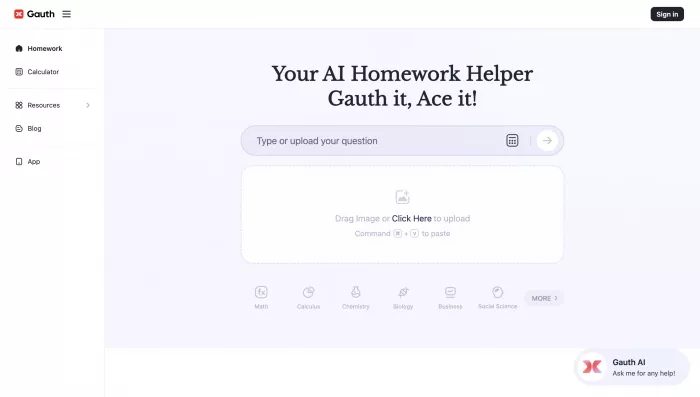
Table of Contents
- Gauth AI, Explained
- Who Built Gauth AI, and When
- Gauth AI in Practice, Step by Step
- Features That Actually Matter
- Gauth AI Accuracy, Broken Down by Subject
- Gauth AI Pricing, Free Tier, and the Billing Trap
- Gauth AI Not Working? Common Issues and Fixes
- Privacy, Data, and the ByteDance Ownership Question
- Is Using Gauth AI Cheating?
- Real User Sentiment: The Ratings Gap
- Advantages and Limitations
- Best Gauth AI Alternatives
- Who Gauth AI Is Best For
- Frequently Asked Questions
- The Verdict
Gauth AI is the homework app that solves math and science problems from a photo, and it is one of the most downloaded education apps in the United States. It is also owned by ByteDance, the company behind TikTok, which is the part most reviews conveniently skip. Here is the honest version. The photo solver works well on school-level math, the step-by-step explanations are genuinely useful, the accuracy drops on advanced problems, and the billing side has generated hundreds of complaints serious enough to deserve their own section. Everything below breaks that down, including what real users actually report.
| Quick facts | Detail |
|---|---|
| Product | AI homework helper, photo-based problem solver |
| Made by | ByteDance, through its subsidiary GauthTech (Singapore) |
| Launched | 2020, originally as Gauthmath |
| Rebranded | To Gauth in 2024, alongside its own "Gauth GPT" model |
| Platforms | iOS, Android, Web, Microsoft Store, Chrome extension |
| Subjects | Math, physics, chemistry, biology, plus writing and humanities |
| Pricing | Free tier with daily limits, Premium around $9.99/month |
| Best for | Quick school-level math, and especially Sparx Maths, used as a tutor not a shortcut |
Gauth AI, Explained
Gauth is an AI-powered homework assistant built around one simple action. You photograph a problem, the app reads it, and it returns a worked solution in a few seconds. The technology underneath combines optical character recognition to read the image, large language models to reason through the problem, and a large database of previously solved questions to match against.
It began life as a pure math solver and has since widened into a general study tool. Current versions cover algebra, geometry, trigonometry, calculus and statistics, extend into physics, chemistry and biology, and add writing help and humanities questions through a built-in chatbot. Gauth markets itself as covering more than 30 subjects across 50-plus languages, and it layers on extras like study timers, a focus mode, and an AI voice tutor. For a student staring at a worksheet at 11pm, the appeal is obvious: instant answers with the working shown, without typing a single equation.
Who Built Gauth AI, and When
This is the question most competing articles never answer, and it matters more than any feature list.
Gauth was launched in 2020 under the name Gauthmath. It was created inside ByteDance by a former math teacher who wanted to help struggling students, and it was built in-house rather than acquired. The app is operated through GauthTech, a Singapore-registered ByteDance subsidiary. Within roughly six months of launch it had passed a million downloads, and by 2024 the company was claiming more than 200 million users worldwide. That April, Gauth sat at number two in the US education app charts on both Apple and Google, behind only Duolingo, as Axios and Forbes both reported.
In 2024 the app rebranded from Gauthmath to Gauth and introduced its own model, Gauth GPT. Worth noting for the technically curious: the chatbot side has historically leaned on third-party models too. A ByteDance spokesperson told Forbes that its chat features were powered by OpenAI technology via a Microsoft Azure license, and that no ByteDance large language models were used for that piece. So Gauth is best understood as a ByteDance product stitched together from OCR, its own model, and licensed external models.
Gauth AI in Practice, Step by Step
Using it is deliberately frictionless, which is both the selling point and the risk.
- You capture a problem with your phone camera, upload an image, or type the question directly.
- The app reads the image, recognizing printed text, symbols, equations, and reasonably clean handwriting.
- It breaks the problem into logical steps rather than jumping straight to a number, identifying the relevant formulas or rules.
- It returns a full worked solution with each step explained, which you can scroll through and compare against your own attempt.
- You can save the solution for revision, or on paid plans escalate to a human tutor when the AI falls short.
That last step is the part Gauth pushes hardest. If the AI cannot solve something, or you want a person to explain it, the app connects you to a live tutor, typically within one to fifteen minutes. Gauth claims a network of around 50,000 experts, based across the United States, India, the Philippines, and parts of Africa, according to ByteDance's statements to Forbes. In practice, several paying users report that tutors bounced their questions back as invalid, so treat this feature as a bonus rather than a guarantee.
Features That Actually Matter
Strip away the marketing and a few features do the heavy lifting:
- The photo solver is the core, and it handles printed textbook problems close to flawlessly and neat handwriting well.
- Step-by-step explanations are the reason it beats a plain calculator, since they show the reasoning rather than just the result.
- Subject breadth is real, covering most school and early-college STEM plus some humanities through the chatbot.
- Multiple solution methods appear on many problems, which helps if your class was taught a different approach.
- Human tutor support acts as a fallback for problems the AI mishandles, though it sits behind a paywall and gets mixed reviews.
- Saved history lets you revisit solved questions, which is useful for exam revision.
- Cross-platform access covers phones, web, the Windows Store, and a Chrome extension, though the desktop experience is noticeably more limited than mobile.
The newer additions, including reading simplification, a writing assistant, focus mode, and the AI voice tutor, are less mature and draw mixed feedback. Treat them as bonuses, not reasons to subscribe.
Gauth AI Accuracy, Broken Down by Subject
Gauth advertises a 95 percent solve rate on K-12 and college STEM questions. That figure comes from Gauth's own marketing, and no independent peer-reviewed benchmark backs it up, so read it as a direction rather than a guarantee. Based on aggregated user reviews and hands-on testing across the review sites, the reality is that accuracy varies sharply by topic.
| Subject area | Reliability | Notes |
|---|---|---|
| Arithmetic, algebra, basic geometry | Very strong | Printed problems near-perfect, clean handwriting handled well |
| High-school physics and chemistry | Strong | Solid on formula-driven work like stoichiometry and kinematics |
| Statistics | Solid | Good on standard distributions and tests, weaker on multivariate |
| Calculus | Good | Reliable on textbook derivatives and integrals |
| Advanced, proof-based, or word problems | Inconsistent | Can produce wrong answers or pull in unrelated formulas |
User reviews echo this sharply, and the complaints are consistent. The most common one is not just wrong answers but a refusal to correct them, with one reviewer noting the AI "REFUSES to change its answer" even after being told the right one. Others describe it returning the wrong subject entirely, one memorably getting "Math equations to a History question". The stakes are real: at least one student relied on it during an exam and wrote plainly, "I actually failed because of it". The lesson those reviews keep repeating is the same as the sensible advice: use Gauth to check and to learn, never as the final word on graded work.
Gauth AI Pricing, Free Tier, and the Billing Trap
Gauth runs on a freemium model. The free tier lets you solve a limited number of problems per day, often just two or three before a paywall, and the desktop version is stingier still. Premium unlocks unlimited answers and fuller explanations, and the tutor plan adds human help on top.
| Plan | Rough cost | What you get |
|---|---|---|
| Free | $0 | A few daily solves, ads, basic answers |
| Premium | Around $9.99/month | Unlimited answers, deeper explanations, no ads |
| Tutor plan | Around $19.99/month | Everything in Premium plus live human tutors |
Two honest caveats. First, pricing is inconsistent. Users report the same trial converting to wildly different amounts, one seeing "$31.99" one day and "$41.99" the next, and prices from $11.99 to $49.99 appear across reviews depending on plan, region, and timing.
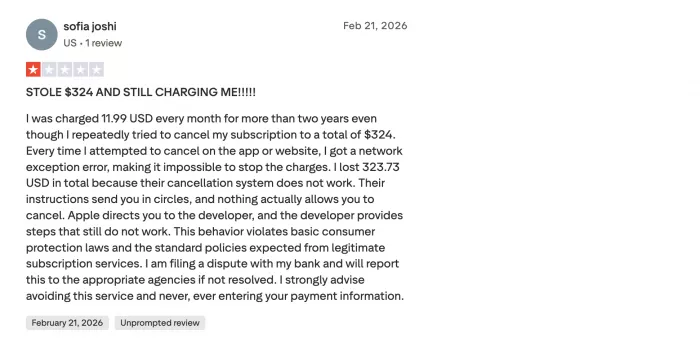
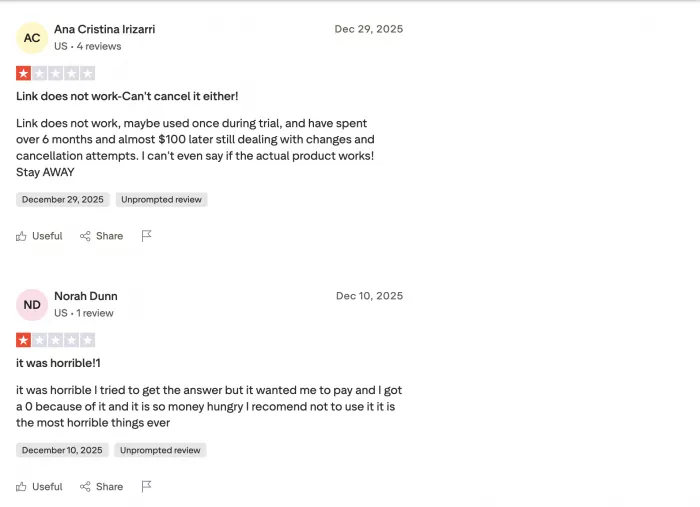
Second, and this is the serious part, the billing complaints dominate Gauth's Trustpilot page and follow one repeating pattern: a three-day free trial that charges the card almost immediately, then a cancellation process that simply does not work. The specifics are damning. One user reports being "charged 11.99 every month for more than two years", losing over $300 because every cancellation attempt threw a network error. Another cancelled inside the trial window and says the "credit card still was charged", with no reply to support emails. A telling recurring detail is that when people try to log back in to cancel, the site tells them their "email isn't registered", locking them out of the very account draining their money. Many end up disputing the charges with their bank because neither the app, Apple, nor Google Play would help.
The practical protection is simple. If you try Gauth at all, subscribe through your Apple or Google account rather than inside the app, so you can cancel cleanly from a system you control, and screenshot the trial terms before you enter card details.
Gauth AI Not Working? Common Issues and Fixes
Enough people search for this that it deserves its own section, and none of the competing guides cover it. If Gauth stops working, the usual culprits and fixes are:
- A weak or dropped internet connection, since Gauth needs to be online to process anything. Switch between Wi-Fi and mobile data to test.
- Server-side outages, which happen occasionally and are outside your control. Wait it out and check whether others are reporting the same.
- The camera failing to scan, usually caused by blurry images, poor lighting, or messy handwriting. Retake the photo with better light and framing.
- Hitting the free query limit, which many users say triggers even after days away, so check whether you have simply run out of daily solves.
- Login or subscription glitches, which often clear after logging out and back in, or restoring purchases through your app store account.
- An outdated app version, so update Gauth from the store, and if problems persist, clear the cache or reinstall.
- Regional availability, which has genuinely been a factor. In January 2025 Gauth briefly went offline for US users alongside other ByteDance apps during the TikTok divestiture enforcement, before being reinstated when enforcement was paused.
That last point is the real one to sit with. Access to Gauth partly depends on ByteDance's legal standing in the US, which no amount of troubleshooting on your end can fix.
Privacy, Data, and the ByteDance Ownership Question
This is the section that separates an honest review from an affiliate pitch. Gauth is a ByteDance app, and it inherits the same data questions that follow TikTok.
According to its own privacy disclosures, Gauth collects registration details, user content such as photos and chats, contacts, purchase information, device identifiers, usage data, and location. In plain terms, it can see which problems you submit, which solutions you open, how long you study, and which subjects you struggle with. The app is intended for users aged 13 and over.
The specific concern that lawmakers have raised is not a documented Gauth breach, because there isn't one. It is that ByteDance, like any company headquartered in China, includes provisions allowing data to be shared within its corporate group, and is subject to Chinese national security laws that could in theory compel disclosure. As the Forbes journalist who first reported on the app put it, the same worries attached to TikTok apply to any ByteDance app. Whether homework photos ever matter in that context is genuinely unknown, but some schools and districts have already restricted ByteDance apps on their networks as a precaution.
If that exposure bothers you, the closest equivalents not owned by a Chinese company are Photomath, which Google acquired in 2022, and Microsoft Math Solver, which is free. This is a personal risk call, not a settled fact, and you should make it deliberately rather than by default.
Is Using Gauth AI Cheating?
Both students and teachers search this, from opposite sides, so it is worth answering plainly.
Using Gauth is not inherently cheating. Using it to understand how a problem is solved, then re-attempting it yourself, is legitimate studying and arguably better than being stuck. Copying its answers straight onto graded work is academic dishonesty by most schools' standards, and it defeats the point entirely, especially given the app is wrong often enough to sink your grade if you trust it blindly. Even some users make the point unprompted, with one arguing that "giving answers" has never helped education. The line is intent: is the app teaching you, or doing the work for you.
Teachers, for their part, are increasingly aware of these tools, which is exactly why threads about detecting them appear high in search results. Solutions phrased in a tool's characteristic style, answers with no working shown, or methods a class was never taught are the usual tells. The sustainable move for students is to treat Gauth as a private tutor you learn from, not a shortcut you hand in.
Real User Sentiment: The Ratings Gap
Gauth's reviews look contradictory until you understand who writes them. On the Apple App Store it holds around 4.9 stars from over 1.6 million reviews, and on Android roughly 4.6 to 4.8 stars. On Trustpilot it sits far lower, closer to 2 stars.
That gap is not noise, it reflects two different audiences. App store ratings come mostly from students who use the photo solver daily and find it close to magical. Trustpilot skews toward adults dealing with billing, cancellations, and customer support, which is precisely where Gauth is weakest. Reading the Trustpilot reviews in bulk makes the split obvious: the negative ones, which dominate, cluster almost entirely around billing and accuracy, while the positive ones cluster around a very different experience.
The strongest recurring praise is oddly specific. Students in the UK love Gauth for Sparx Maths and MathsWatch. Because it has access to much of the Sparx question bank, users report it can essentially guarantee the right answer on those platforms, with one calling it a "must use website for Sparx maths". That is a real, narrow strength worth knowing about. Elsewhere, the warmest reviews come from students who reach for it when a parent cannot help, one writing it is "so helpful when my parents can't help me", and others crediting it for grades that "really improved".
Taken together, the reviews tell a coherent story. When Gauth works, on a standard problem, a Sparx question, or a concept a student wants explained, people genuinely love it. When it fails, on a hard problem, a broken subscription, or an impossible cancellation, people feel scammed. Both reactions are earned, and knowing which situation you are in is the whole game.
Advantages and Limitations
| Advantages | Limitations |
|---|---|
| Fast solutions, usually within seconds | Accuracy drops on advanced and word problems |
| Clear step-by-step explanations | Free tier is limited to a few daily solves |
| Broad STEM coverage plus some humanities | Widespread billing and cancellation complaints |
| Excellent for Sparx Maths and MathsWatch | Refuses to correct its own wrong answers |
| Human tutor fallback on paid plans | ByteDance data and privacy questions |
| Works across phone, web, and browser | Desktop version weaker than mobile |
| Cheaper than a private tutor | Access can be disrupted by regulatory action |
Best Gauth AI Alternatives
Gauth is not the only option, and for some students it is not the best one. Here is how the main alternatives compare.
| Tool | Best for | Free steps? | Standout strength | Weak spot |
|---|---|---|---|---|
| Photomath | School math, owned by Google | Partly | Clean step-by-step logic | Weaker on word problems |
| Symbolab | Advanced and college math | Limited | Powerful symbolic engine | Steeper learning curve |
| Mathway | Broad STEM speed | No | Wide topic coverage, fast | Steps need premium |
| Socratic | Multi-subject school help | Yes, free | Explains concepts across subjects | Weak on advanced math |
| Chegg | Deep tutoring and textbooks | No | Real human experts | Expensive |
| ChatGPT or Claude | Conceptual understanding | Yes | Flexible, conversational depth | Math formatting can be rough |
| Microsoft Math Solver | Free, non-ByteDance math help | Yes | Genuinely free with steps | Narrower than Gauth |
In short, reach for Photomath or Symbolab when you want clear math steps, Socratic or a general AI chatbot when you need help across subjects, Chegg when you want a human to teach you, and Microsoft Math Solver if you want a free tool without the ByteDance question or the billing horror stories attached.
Who Gauth AI Is Best For
- It suits middle and high school students who need quick, reliable help on standard math and science homework.
- It is genuinely strong for UK students using Sparx Maths or MathsWatch, where its question-bank coverage makes answers dependable.
- It works for anyone who learns better from seeing worked steps than from reading a textbook.
- It is a poor fit for advanced, proof-heavy, or research-level work where accuracy matters most.
- It is the wrong choice if ByteDance data handling is a dealbreaker, or if you are wary of a subscription that many users struggle to cancel.
Frequently Asked Questions
What is Gauth AI?
Gauth AI is an AI homework helper that solves math and science problems from a photo, showing step-by-step explanations. It also offers human tutor support on paid plans.
Who made Gauth AI?
Gauth was built by ByteDance, the company behind TikTok, through its Singapore-based subsidiary GauthTech. It was created in-house, not acquired.
When was Gauth AI created?
It launched in 2020 as Gauthmath and was rebranded to Gauth in 2024, when ByteDance added its own Gauth GPT model.
Is Gauth AI free?
There is a free tier with a limited number of daily solves and ads. Unlimited answers and deeper explanations require a Premium subscription of around $9.99 a month, and live tutors cost more.
Is Gauth AI a scam?
The app itself is a real product, not a fake one. However, a large number of users report predatory billing: trials that charge immediately and cancellations that fail repeatedly. Treat the tool as legitimate but the subscription as something to manage carefully through your app store.
How accurate is Gauth AI?
It is very reliable on school-level algebra, geometry, and formula-based physics and chemistry, and less reliable on advanced, proof-based, or word problems. Its advertised 95 percent solve rate is a company claim, not an independently verified figure.
Is Gauth AI safe to use?
The app uses standard security, but it collects significant data and is owned by ByteDance, which raises the same privacy questions as TikTok. Avoid sharing unnecessary personal information, and be aware some schools restrict ByteDance apps.
Why is Gauth AI not working?
The usual causes are a poor internet connection, a temporary server outage, a blurry photo, hitting the daily free limit, or an outdated app. Access has also been disrupted before by regulatory action against ByteDance.
Is using Gauth AI cheating?
Using it to learn how a problem is solved is legitimate. Copying its answers directly onto graded work is cheating, and risky given it is often wrong on harder questions.
What are the best Gauth AI alternatives?
Photomath and Symbolab for math, Socratic for multi-subject school help, Chegg for human tutoring, general AI chatbots for concepts, and Microsoft Math Solver for a free, non-ByteDance option.
The Verdict
Gauth is a fast, capable homework helper that does exactly what it promises on the problems most students actually face, and it is genuinely excellent for Sparx Maths, where its question-bank coverage makes it hard to beat. The caveats are equally real and, in the case of billing, serious. Accuracy falls away on hard problems, the app refuses to correct itself, and the volume of unauthorized-charge and failed-cancellation complaints is impossible to ignore. Used deliberately, as a tutor you learn from and a subscription you control through your app store, it earns its place. Used blindly, as a source of truth to copy from or a trial you forget to cancel, it will cost you either your grade or your money. Go in knowing which one you are doing.

Comments