Fintechzoom.com S&P 500: Is It a Reliable Market Resource or Just Another Aggregator?

Shubham Sharma

Table of Contents
- Why FintechZoom’s S&P 500 Content Attracts Attention
- What Fintechzoom.com S&P 500 Actually Offers
- The Role of Commentary vs Original Analysis
- Data Feeds, Syndication, and Third-Party Dependence
- The “Magnificent Seven” Narrative and Market Concentration
- The Strategic Consulting Section Raises Structural Questions
- How the Crypto Section Impacts Overall Credibility
- Is Fintechzoom.com S&P 500 Data Wrong?
- Who Is FintechZoom’s S&P 500 Content Actually For?
- Final Verdict: Is Fintechzoom.com S&P 500 Worth Using?
When people search for S&P 500 data, market analysis, or index-level insights, the phrase fintechzoom.com sp500 increasingly appears in search results. At first glance, FintechZoom presents itself as a comprehensive financial platform offering real-time index tracking, stock analysis, crypto coverage, and even strategic consulting services.
But credibility in financial information is not determined by appearance alone. It is determined by transparency, methodology, and verifiable expertise. This article takes a careful and non-promotional look at FintechZoom’s S&P 500 coverage, examining what the platform actually provides, where its strengths lie, and where meaningful questions remain unanswered.
Why FintechZoom’s S&P 500 Content Attracts Attention
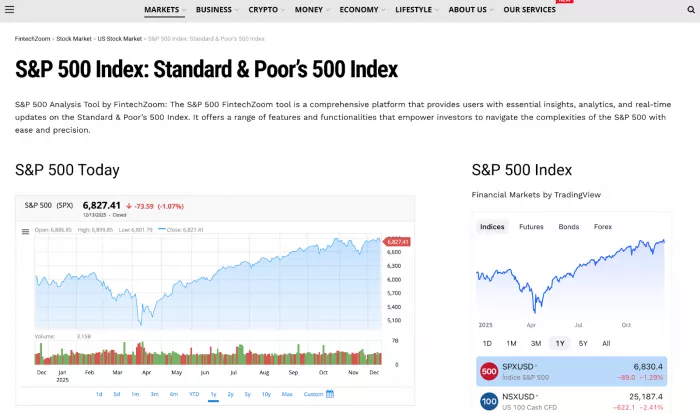
The S&P 500 is one of the most closely watched financial indices in the world. Any platform that claims to track it in real time naturally attracts investors, traders, and casual readers alike.
FintechZoom positions its S&P 500 section as a dedicated analysis hub. The site offers daily index updates, headline-driven market commentary, and embedded TradingView charts. For users who want a quick snapshot of index movement, this setup feels accessible and straightforward.
However, accessibility alone does not equal authority.
What Fintechzoom.com S&P 500 Actually Offers
Based on direct inspection of the platform, FintechZoom’s S&P 500 coverage includes the following elements:
● Real-time index price tracking, largely powered by TradingView integrations
● Short-form market news articles discussing daily index movements
● Opinion-style analysis pieces tied to earnings, Federal Reserve events, or large-cap stock performance
● Basic educational explanations about index mechanics, ETFs, and futures
● Links to related instruments, such as Vanguard S&P 500 ETFs and S&P 500 futures
From a functional standpoint, this makes FintechZoom a market aggregation layer, not a primary data source. The data itself appears to be syndicated or embedded, not independently generated.
The Role of Commentary vs Original Analysis
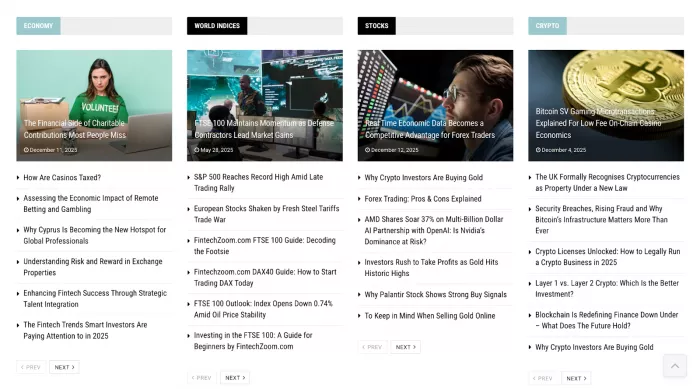
One of the most important distinctions in financial media is the difference between commentary and analysis.
FintechZoom’s S&P 500 articles tend to focus on describing what happened, not proving why it happened. Headlines such as record highs, late trading rallies, or tech-driven momentum are framed in accessible language, but they rarely include:
● Primary data citations
● Quantitative models
● Methodological disclosures
● Scenario-based forecasting
This does not make the content incorrect, but it does place it firmly in the category of interpretive reporting, not research-grade analysis.
Data Feeds, Syndication, and Third-Party Dependence
FintechZoom does not clearly disclose:
- Which market data providers it uses
- Update frequencies
- Whether delays or adjustments apply
The reliance on TradingView charts strongly suggests third-party syndication. While TradingView itself is widely trusted, the lack of explicit disclosure prevents users from fully understanding data provenance.
Transparency around data sourcing is standard practice among high-trust financial platforms and its absence here is a notable gap.
The “Magnificent Seven” Narrative and Market Concentration
FintechZoom frequently references the concentration of S&P 500 gains among large-cap technology stocks, often referred to as the Magnificent Seven. This mirrors commentary found on more established platforms like CNBC and FastBull.
The issue here is not accuracy, but originality. The arguments presented are widely circulated across financial media. FintechZoom does not appear to add new datasets, alternative perspectives, or independent modeling to this discussion.
As a result, readers are consuming repackaged consensus views, not differentiated insight.
Transparency Gaps in Editorial Structure
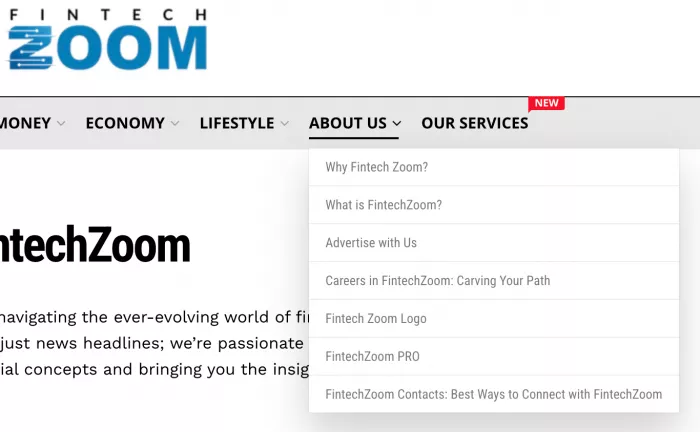
A major concern when evaluating any financial platform is who is responsible for the content.
FintechZoom’s About Us page uses broad language such as “team of financial journalists and analysts”, yet it provides:
● No named analysts
● No verifiable credentials
● No individual author biographies
● No editorial standards or review policies
In contrast, established financial publications clearly disclose editorial leadership, compliance policies, and conflict-of-interest frameworks. The absence of these elements makes it difficult to evaluate accountability behind FintechZoom’s S&P 500 commentary.
The Strategic Consulting Section Raises Structural Questions
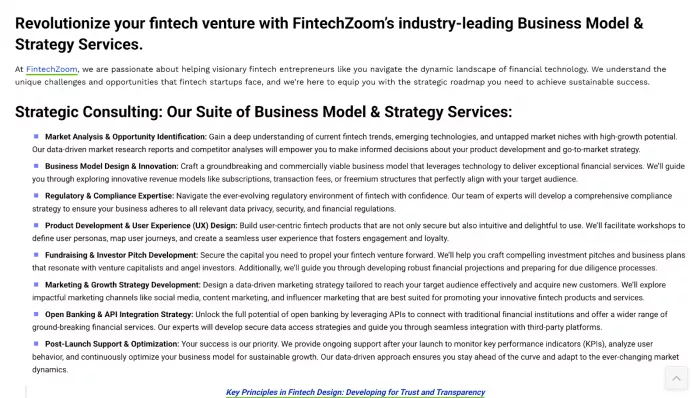
Beyond market content, FintechZoom also promotes strategic consulting services aimed at fintech startups. This creates a structural contradiction.
A platform that simultaneously:
● Publishes market analysis
● Offers consulting services
● Promotes VIP trading signals
● Hosts affiliate-style financial content
faces an inherent conflict of interest risk.
There is no clear separation between editorial content and commercial services. Without explicit disclosures, readers cannot easily determine whether S&P 500 commentary is purely informational or indirectly tied to lead generation or sales funnels.
How the Crypto Section Impacts Overall Credibility

FintechZoom’s crypto section contains extensive educational material, some of which dates back several years. While some articles are informative, others rely on dated statistics, generic explanations, and overly broad claims.
This matters because a platform’s weakest sections often reveal its overall editorial discipline. The crypto archive shows signs of content recycling, long publication gaps, and minimal updates, which raises reasonable concerns about ongoing accuracy maintenance.
When applied to S&P 500 coverage, this pattern suggests that freshness and verification may not always be a priority.
Is Fintechzoom.com S&P 500 Data Wrong?
It is important to be precise here.
FintechZoom’s S&P 500 numbers are not inherently wrong. They appear to rely on standard market feeds and well-known charting tools. Users checking index levels, daily percentage changes, or broad trend direction are unlikely to encounter factual errors.
The issue is not data accuracy, but interpretive reliability.
Without transparency around authorship, methodology, or incentives, readers cannot assess why certain narratives are emphasized or how conclusions are formed.
Who Is FintechZoom’s S&P 500 Content Actually For?
FintechZoom appears best suited for:
- Casual readers seeking market awareness
- Students learning basic financial concepts
- Users wanting quick snapshots of index movement
It is not well suited for:
- Investment decision-making
- Risk modeling
- Long-term portfolio strategy
- Institutional or academic research
Final Verdict: Is Fintechzoom.com S&P 500 Worth Using?
The answer depends entirely on expectations.
Fintechzoom.com sp500 is not a scam, and it does not appear to deliberately publish false market data. However, it is also not a high-trust financial authority.
It operates primarily as a market content aggregator, combining syndicated data, simplified explanations, and broad commentary under one brand. The lack of author transparency, editorial separation, and methodological clarity prevents it from being considered a reliable source for serious financial decisions.
The safest conclusion is this:
FintechZoom’s S&P 500 section can be read for general awareness, but it should not be relied upon for investment judgment.
In modern finance, credibility is built on disclosure, not presentation. Until FintechZoom clearly shows who stands behind its analysis and how its conclusions are formed, its S&P 500 content remains informational at best, and incomplete at worst.

Comments