CloudElder.com in 2026: What it Really is, Who It's Really For, and When to Skip It

Rajat Chauhan
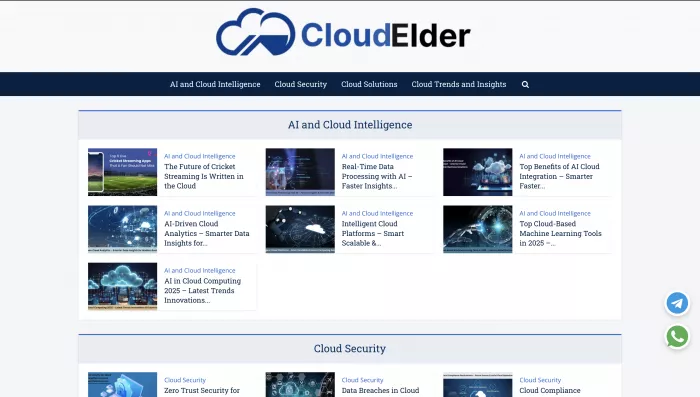
Table of Contents
- What Is CloudElder.com, Really?
- Is CloudElder.com Safe and Legit?
- CloudElder for Cloud Learners: What You Actually Get
- CloudElder for SEO and Guest Posts: Worth the Investment?
- Who Should Use CloudElder — and Who Shouldn't
- CloudElder vs. Alternatives: Honest Comparison
- How to Get Maximum Value from CloudElder
- Ownership and Transparency
- Frequently Asked Questions
- Final Verdict
If you just searched "cloudelder com," you're almost certainly trying to answer one of three questions: What is this site? Is it safe? And is it worth my time or money?
You likely fall into one of two camps: you stumbled upon their content while researching cloud computing and want to know if it's reliable, or you saw the brand name somewhere and are wondering whether this is a legitimate company or just another content farm.
This guide answers every version of those questions with evidence from independent reviews, first-hand site analysis, and publicly available data — not marketing copy.
What Is CloudElder.com, Really?
Let's clear up the biggest point of confusion immediately.
CloudElder.com is a digital media hub focused on cloud technology education, with a strong secondary role as an SEO and guest posting platform. It exists in the space between traditional tech publications and actual service providers.
CloudElder is a blog that teaches cloud concepts and sells guest-post placements. It is not AWS. It is not Azure. It does not host your data or manage your infrastructure.
It publishes beginner-friendly articles about cloud computing and technology trends. It is not a cloud service provider, hosting company, or software vendor.
What CloudElder Covers
The content focuses on practical implementation — how to migrate data, which tools to compare, what mistakes to avoid. It targets people who already know they need cloud solutions but don't know where to start: tech-adjacent business owners, marketing managers handling digital transformation, and small IT teams without deep infrastructure experience.
Articles walk through migration considerations, cost comparisons, and use case scenarios across the big three providers — AWS, Azure, and Google Cloud. The value is translation: cloud providers offer documentation written for people who already understand enterprise infrastructure. CloudElder rewrites that information for everyone else.
One of CloudElder's main angles is demystifying automation and cloud adoption for non-technical owners. They break down concepts like API integrations, automated backups, and remote system monitoring without drowning you in technical specifications. For someone running a 10-person company who needs to modernize their tech stack, this approach genuinely helps.
The Guest-Post and SEO Side
Let's be direct: CloudElder.com sells guest posting opportunities. This isn't a secret — it's an open part of their business model.
A dofollow link from CloudElder passes actual SEO value. It's not just a vanity link — it can genuinely help a website rank better for competitive keywords. For agencies working with tech, SaaS, or digital transformation clients, that makes CloudElder worth evaluating.
So you've got two audiences using the same platform for completely different reasons. Business owners read it for cloud guidance. Marketers use it for link building. Both groups find value, which explains the dual reputation.
The Topical Drift Problem
One issue that undermines CloudElder's positioning deserves honest mention. The site's tagline describes it as "your go-to hub for gaming, tech, and lifestyle content." Cloud security articles sit alongside gaming reviews and home improvement tips, which weakens its credibility as a cloud computing authority. For a site positioning itself as a cloud education resource, this dilution is a real weakness.
Is CloudElder.com Safe and Legit?
This is the question most people are actually asking when they search "cloudelder com."
The Short Verdict
CloudElder.com is a legitimate digital publisher — not a scam, not a cloud service provider, and not a security threat.
Cybersecurity Assessment
From a cybersecurity perspective, CloudElder.com is safe to visit. The site uses valid SSL/HTTPS encryption, shows no malware or phishing indicators, requires no account creation or payment, and publishes a privacy policy. You will not compromise your device, data, or finances by browsing. There are no warning signs of aggressive pop-ups or harmful redirects.
Trust Score Reality
This is where the picture gets more nuanced. Third-party review platforms consistently assign CloudElder a "medium" trust score — not flagged as dangerous, but missing the transparency signals that establish genuine authority.
Present: Professional design, regular updates, SSL encryption, privacy policy, some backlink authority (DR 26), no evidence of fraud.
Missing: Detailed ownership information, verified author credentials, substantial independent reviews or testimonials.
However, "legitimate" and "authoritative" are not the same thing. CloudElder suffers from significant transparency issues regarding author credentials and ownership and should not be used as a primary source for professional certification study or enterprise-level decision-making.
Is CloudElder.com a scam? No. It publishes real articles, doesn't charge readers money, and poses no security threats. The "scam" searches stem from limited ownership transparency and missing author credentials — not fraudulent behavior.
Bottom line: Safe to browse. Legitimate as a publisher. Not authoritative enough for high-stakes professional or enterprise decisions.
CloudElder for Cloud Learners: What You Actually Get
Strengths for Beginners
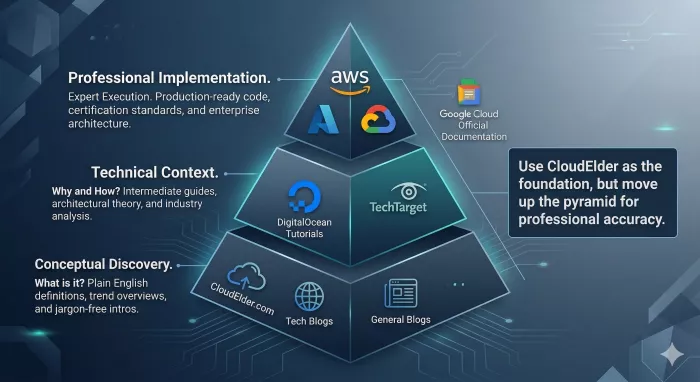
If you're new to cloud computing and official AWS or Azure documentation makes your eyes glaze over, CloudElder fills a genuine gap. Big cloud providers offer powerful tools, but their documentation can feel impenetrable to newcomers. CloudElder explains these ideas in plain words.
The content covers cloud basics, security tips, digital transformation, and other topics that help people learn about modern tech trends. They're not trying to turn you into a systems architect — they're giving you enough knowledge to make informed decisions and talk intelligently with actual service providers.
The Depth Ceiling
Here's where you need to manage expectations. Content stays at the conceptual level: you will learn what hybrid cloud means on CloudElder. You will not learn how to architect one.
Security content tends toward the practical rather than deeply technical. You'll find articles about encryption basics, two-factor authentication setup, and data backup strategies — but not penetration testing tutorials or advanced cryptography.
CloudElder only educates — it doesn't implement cloud infrastructure or managed services. If you need deep technical tutorials or hands-on guidance, this platform alone won't be enough.
The Author Credibility Gap
Articles carry author names but no biographical information, professional credentials, certifications, industry experience, LinkedIn profiles, or portfolio links. Guest posts (paid contributions) appear alongside staff content with no clear distinction. This makes it difficult for readers to judge the credibility and expertise behind any given article.
How CloudElder Compares to AWS Documentation
CloudElder is far more accessible and beginner-friendly. AWS documentation is far more accurate, comprehensive, and authoritative. Use CloudElder to understand what a concept means. Use AWS docs to implement it correctly.
CloudElder for SEO and Guest Posts: Worth the Investment?
How the Guest-Post Model Works
CloudElder maintains content quality standards that protect their domain authority. They require submissions to meet editorial thresholds and manually review them rather than using automated systems, which maintains quality but slows down the process. This selective approach keeps their domain valuable for SEO purposes.
SEO Value Assessment
CloudElder's DR of 26 puts it in mid-tier territory. It sits above bulk-link farms but below established tech media. The strongest link profiles are built from diversified, contextually relevant, human-edited articles — not mass AI content or "100 guest posts for $200" bundles.
For marketers evaluating a CloudElder placement, the key factors are niche relevance and domain metrics. A cloud-focused placement makes sense for SaaS and tech brands; it makes less sense for unrelated industries.
The Social Proof Gap
For a platform with measurable traffic and active guest posting, there are surprisingly few public reviews. Reddit mentions are minimal, mostly in SEO subreddits. There's no Trustpilot profile. Independent blog reviews exist but with limited depth. This lack of social proof doesn't prove anything negative, but it means you're taking more on faith than with well-reviewed alternatives.
Exact pricing is not publicly listed and typically requires direct inquiry.
Who Should Use CloudElder — and Who Shouldn't
✅ Use CloudElder When…
You're hearing a cloud term for the first time and need a jargon-free explanation. CloudElder uses simpler language where newcomers can easily understand cloud computing concepts.
You're a small business owner without an IT team. The explainers help business owners without big IT departments make better decisions when talking with cloud providers or IT consultants.
You need a niche-relevant backlink for a tech or SaaS brand. Guest posts offer dofollow backlinks that carry real link equity and can enhance search engine rankings.
You want free, no-registration cloud content. All content is free with no paywalls, subscriptions, or registration requirements.
❌ Skip CloudElder When…
You're studying for cloud certifications. CloudElder should not be used as a primary source for professional certification study. Use official vendor training or dedicated platforms like Pluralsight, Cloud Academy, or KodeKloud.
You need hands-on labs or practical implementation guides. CloudElder publishes articles, not interactive sandboxes. For hands-on learning, look at DigitalOcean Community Tutorials, AWS Hands-On Tutorials, or Google Cloud Skills Boost.
You need citable, authoritative sources. The lack of verified author credentials makes it unsuitable for citation in professional or academic work. Use official vendor documentation or peer-reviewed publications.
You need enterprise-level technical depth. CloudElder offers general orientation, not definitive guides for complex technical problems.
The One-Line Rule
CloudElder is a starting point, not a destination.
CloudElder vs. Alternatives: Honest Comparison
| Factor | CloudElder.com | Official Cloud Docs (AWS/Azure/GCP) | Course Platforms (Pluralsight, Cloud Academy) | Generic Guest-Post Networks |
|---|---|---|---|---|
| Purpose | Education + SEO placements | Technical reference | Structured learning + certification | Link selling |
| Best For | Beginners, SMBs, marketers | Engineers, developers | Serious learners pursuing credentials | SEOs seeking volume |
| Content Depth | Introductory–intermediate | Intermediate–advanced | Beginner–advanced (structured) | Shallow |
| Hands-On Labs | None | Limited examples | Yes — interactive sandboxes | None |
| Cost | Free content; paid guest posts | Free docs | $29–$79/month typical | Paid placements |
| Trust Level | Medium | Very high | High | Low–medium |
| Author Credentials | Not visible | Official vendor teams | Named, credentialed instructors | Varies |
| SEO Value | Mid-tier niche links (DR 26) | N/A | Indirect | Varies |
When Each Alternative Wins
For conceptual orientation: CloudElder works as a free starting point for simplified learning.
For certification prep: A Cloud Guru, Pluralsight, Coursera Cloud Specializations, AWS Skill Builder, Microsoft Learn, and Google Cloud Training.
For hands-on practice: Platforms offering interactive playgrounds where students can SSH into disposable servers or access multi-server environments directly from browsers.
For authoritative cloud news: TechTarget SearchCloudComputing, TechCrunch, The New Stack.
For community discussion: Reddit (r/cloudcomputing, r/aws), Stack Overflow, Dev.to.
How to Get Maximum Value from CloudElder
If you've decided CloudElder fits your use case, here's how to use it smartly.
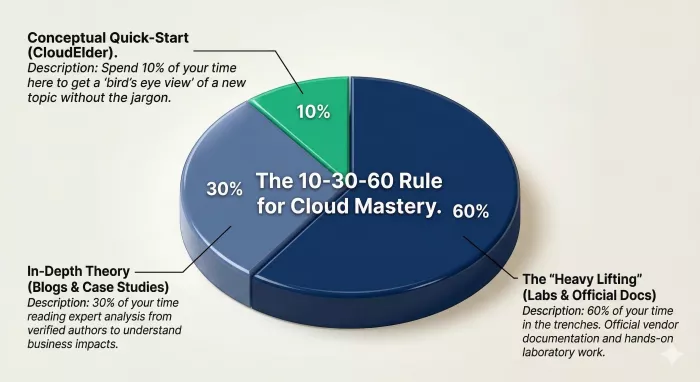
For learners: When you learn something technical from the site, verify it against official documentation from AWS, Azure, or Google Cloud. Treat CloudElder articles as orientation, then go deeper with vendor docs or structured courses.
For marketers considering a guest post: Only invest if CloudElder's niche relevance aligns with your brand. One strong link from a trusted site beats ten cheap ones. If it fits your niche and budget, it can be part of a diversified link profile — but shouldn't be your only link-building investment.
For everyone: Don't share sensitive personal or financial information on any informational site. Cross-reference any technical guidance before implementation. The platform's future success depends on adapting content to address AI-powered cloud tools, adding transparency around authorship, and maintaining editorial standards.
Ownership and Transparency
This section exists because transparency is the single most common concern in reviews.
CloudElder's ownership details are limited. The site presents itself as a professional IT and cloud solutions provider but offers little verified information about its founders, physical address, or legal registration. This is common for newer or smaller websites, but transparency is an important factor for sites publishing informational content.
When searching for CloudElder reviews across the internet, results are limited — very few verified customer experiences or ratings on trusted platforms like Trustpilot, SiteJabber, or Reddit. Most discussions appear on smaller blogs and forums where users question legitimacy rather than share success stories.
CloudElder isn't hiding something nefarious. But the absence of visible leadership, editorial policies, and author bios is a legitimate gap that users should factor into how much weight they give any single article.
Frequently Asked Questions
What is CloudElder.com?
An educational content platform publishing beginner-friendly articles about cloud computing and technology trends. Not a cloud service provider, hosting company, or software vendor.
Is CloudElder.com a scam?
No. It publishes real articles, doesn't charge readers, and poses no security threats. The "scam" searches come from limited ownership transparency, not fraudulent behavior.
Is CloudElder.com safe to visit?
Yes. The site uses SSL encryption, contains no detected malware, and doesn't require personal data or payment.
Is CloudElder a cloud hosting or SaaS provider?
No. It's a digital hub for learning about cloud computing, not a company selling servers or hosting services.
Does CloudElder cost money to read?
No. All content is free with no paywalls, subscriptions, or registration requirements.
Can I publish guest posts on CloudElder?
Yes. They accept contributed articles and offer dofollow backlinks with real link equity.
Are CloudElder guest posts worth it for SEO?
For the right audience — tech or SaaS brands seeking niche-relevant placements — it delivers value. DR 26 puts it in mid-tier territory, above bulk farms but below established tech media.
Will CloudElder help me pass AWS/Azure certifications?
No. It shouldn't be used as a primary certification study source. Use it for initial orientation, then switch to official vendor training or dedicated platforms.
What are the best CloudElder alternatives?
Depends on your goal. Hands-on learning: DigitalOcean, AWS labs. News: TechTarget, TechCrunch. Certifications: A Cloud Guru, Coursera, official vendor training. Reference: AWS, Azure, Google Cloud docs. Community: Reddit, Stack Overflow.
Who owns CloudElder.com?
Ownership details are limited. The site offers little verified information about founders, physical address, or legal registration.
Should I cite CloudElder in a report or research paper?
No. The lack of verified author credentials makes it unsuitable for citation. Use official vendor documentation or peer-reviewed publications.
Does CloudElder have hands-on labs?
No. It publishes static articles and guides. For interactive cloud learning, look at platforms with browser-based lab environments.
How often is CloudElder content updated?
The site regularly updates articles to include latest cloud advancements, though update frequency and depth vary by category.
Does using CloudElder require registration?
No. You can access all content without creating an account or providing any personal information.
Final Verdict
CloudElder.com occupies a real — if narrow — niche in 2026. It translates dense cloud documentation into accessible language for non-technical readers and offers niche-relevant link-building opportunities for tech and SaaS marketers. Both have genuine value.
But it's critical to know what it isn't: it isn't a cloud provider, it isn't a certification prep platform, and it isn't an authoritative source for enterprise decision-making. The transparency gaps around ownership and authorship are legitimate concerns, not deal-breakers.
CloudElder is a starting point, not a destination.
Use it for what it's good at — beginner orientation and selective SEO placements — and you'll get real value. Expect more than that, and you'll be disappointed. The smartest approach is to pair CloudElder's plain-English explainers with deeper, more authoritative resources for any concept that actually matters to your business, career, or technical implementation.

Comments