What Is Class Companion? Features, Pricing, How It Works, and How It Compares

Rajat Chauhan
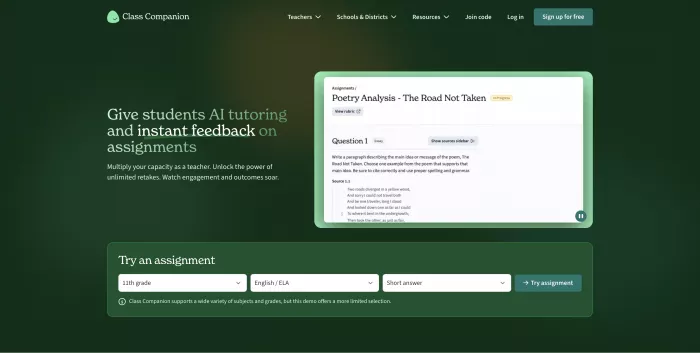
Grading 30 student essays takes most teachers five to eight hours. Class Companion was built to change that math — not by removing the teacher, but by giving them an AI assistant that handles initial feedback and grading while the teacher keeps final authority over every score.
Founded in 2017 by Avery Pan and acquired by Panorama Education in April 2025, Class Companion is used in more than 25,000 schools and 500 districts across the United States. It combines automated grading, instant written feedback, and an AI tutor called Ditto — all powered by OpenAI's GPT-4 and designed to operate entirely under teacher direction.
This guide covers how Class Companion works for teachers and students, what it costs, how it compares to Turnitin and other alternatives, and what the Panorama acquisition means going forward.
How Class Companion Works
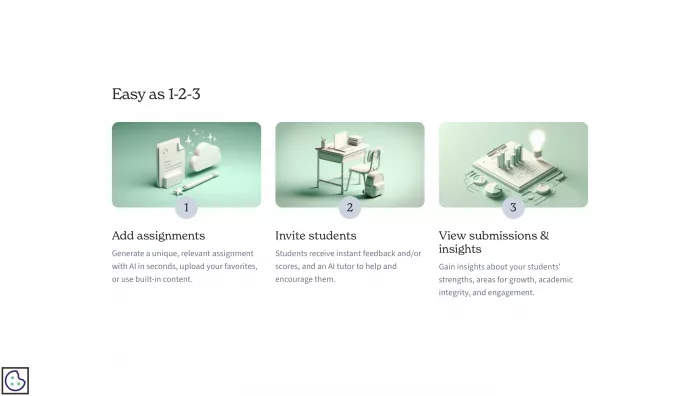
Class Companion follows a six-step workflow that keeps the teacher at the center.
- The teacher creates an assignment and attaches a rubric, built from scratch or selected from standards-aligned templates.
- The assignment publishes to Google Classroom automatically if connected.
- Students open the assignment and submit their responses.
- GPT-4 evaluates the submission against the rubric and delivers a score plus specific written feedback within seconds.
- Students revise and resubmit. Teachers control how many attempts are allowed.
- If a student disagrees with the AI's feedback, they file an appeal. The teacher reviews and makes the final call.
The AI handles initial evaluation, but the teacher sets every parameter and holds override authority on every grade.
The Teacher Experience
After signing up with a free account, teachers connect Google Classroom, create or import a rubric, and build their first assignment. The platform includes an assignment generator that produces relevant prompts in seconds, though teachers can write their own.
Once an assignment is live, the dashboard shows submissions in real time, flags struggling students, and surfaces class-wide trends through an insights panel. Teachers can review any AI-generated grade before it reaches the student, adjust scores manually, and use the data to guide instruction.
The platform is built for formative assessment — low-stakes, feedback-rich assignments focused on improvement over multiple attempts — rather than high-stakes summative testing.
The Student Experience
Students access Class Companion through a link from their teacher or through Google Classroom. No app download is needed. If the school uses Google Classroom integration, students typically do not need a separate account.
After submitting a response, students receive a score and specific feedback within seconds. If multiple attempts are enabled, they revise and resubmit.
Students can also interact with Ditto, the built-in AI tutor. Ditto works as a conversational coach — it does not provide answers but asks guiding questions to help students think through their reasoning. Teachers can view all Ditto interactions.
If a student believes the AI's feedback is unfair, the appeal system lets them flag it. The teacher then reviews and makes the final determination.
Key Features
AI Grading and Instant Feedback — GPT-4 evaluates student responses against teacher-defined rubric criteria, providing detailed commentary on what the student demonstrated and where they fell short. This is the core value proposition for teachers spending hours on margin comments.
Ditto, the AI Tutor — A conversational AI that guides students through difficult questions without giving away answers. Unlike raw ChatGPT, Ditto is constrained to the assignment context and operates within teacher-set boundaries.
Google Classroom Integration — Assignments publish directly to Google Classroom. Grades sync back. No dual-platform management required.
Custom Rubric Builder — Teachers build rubrics from scratch or use pre-built templates. The rubric quality directly determines feedback quality, since the AI evaluates against these criteria.
Student Appeal System — Students can formally dispute scores or feedback. The teacher reviews and decides. This acknowledges that AI grading is not infallible and gives students a voice.
Insights Dashboard — Tracks individual progress and flags class-wide patterns. If most students struggle with thesis statements, the dashboard surfaces that so the teacher can adjust instruction.
Test Prep Mode — Includes dedicated content for AP exam preparation and standardized test practice with AI feedback aligned to exam rubrics.
Multiple Attempt Controls — Teachers set submission limits, supporting mastery-based learning where the goal is improvement over time.
Pricing
Class Companion offers a free plan for individual teachers with access to core features — assignment creation, AI grading, feedback, and Google Classroom integration.
Premium and district-level plans exist but exact pricing is not publicly listed. Districts contact Panorama Education directly for quotes. This is standard in K-12 EdTech, where pricing varies by district size and contract terms.
For teachers evaluating the tool, the free plan is functional enough for a meaningful pilot.
Who Owns Class Companion Now
On April 23, 2025, Panorama Education acquired Class Companion. Panorama works with more than 500 school districts, providing data analytics, student support tools, and intervention platforms.
Co-founder Avery Pan continues to lead the product within Panorama. The acquisition places Class Companion alongside Panorama Solara, a customizable AI platform for districts, signaling that Panorama is building a broader AI suite for schools.
For existing users, day-to-day functionality has not changed. The platform continues at classcompanion.com with the same core features. The primary impact is expanded reach through Panorama's district relationships and institutional credibility — particularly useful for administrators navigating procurement processes.
Class Companion vs. Competitors
| Factor | Class Companion | Turnitin | Formative | Khan Academy (Khanmigo) |
|---|---|---|---|---|
| Primary Use | AI grading and tutoring | Plagiarism detection and feedback | Real-time formative assessment | Student AI tutoring |
| Grade Level | K-12 | Higher ed and K-12 | K-12 | K-12 |
| Free Plan | Yes | No | Limited | Yes |
| AI Tutor | Yes (Ditto) | No | No | Yes (Khanmigo) |
| Google Classroom | Native | Partial | Yes | No |
| Teacher Override | Full control | Yes | Yes | Minimal |
| Essay Grading | Core feature | Yes | Basic | No |
| Student Appeal | Yes | No | No | No |
vs. Turnitin — Turnitin's strength is plagiarism detection, with feedback tools layered on top. It carries significant licensing costs and is typically purchased institutionally. Class Companion focuses on formative AI grading and tutoring, offers a free tier, and is more accessible for individual teachers. Different primary functions for different primary needs.
vs. Formative — Formative supports a wide range of question types and excels at real-time checks for understanding. It lacks the depth of AI-driven essay feedback and has no AI tutoring component. Class Companion is more specialized for writing; Formative has broader scope across question formats.
vs. Khan Academy (Khanmigo) — Khanmigo provides 1:1 AI coaching across multiple subjects but does not include teacher-controlled grading, rubric-based assessment, or assignment management. Khanmigo is student-facing; Class Companion is teacher-directed. They could work alongside each other.
What Teachers Say
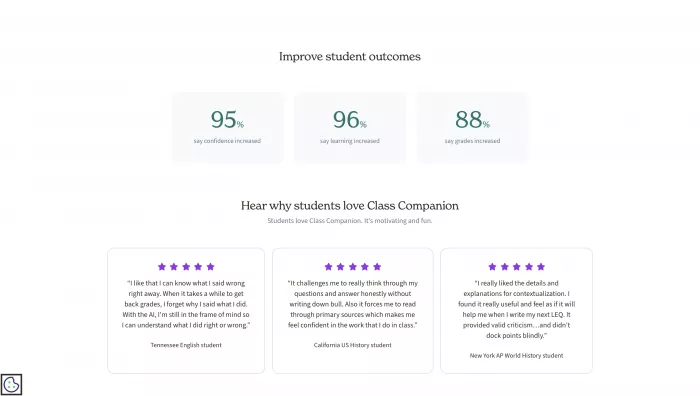
Positive feedback centers on time savings (five to six hours per week reported by some teachers), immediate student engagement with feedback, the appeal system encouraging self-advocacy, and frictionless Google Classroom integration.
Common criticisms include occasional inconsistency in AI feedback on nuanced or creative writing, subject coverage limited primarily to ELA and social studies, a need for more rubric templates, and insufficient pricing transparency for premium features.
Catlin Tucker, an education author and practitioner, reviewed the platform in the context of blended learning. TechLearning published a hands-on walkthrough. Forbes featured it in 2023, focusing on how AI assists teachers rather than replacing them.
Pros and Cons
Pros
- Free plan for individual teachers
- GPT-4 grading delivers fast, specific feedback
- Ditto coaches students without giving answers
- Native Google Classroom integration
- Full teacher control over assignments, rubrics, and final grades
- Student appeal system builds trust
- Panorama Education backing adds credibility
- Validated across 25,000+ schools
Cons
- Primarily writing and ELA focused; limited STEM coverage
- AI can be inconsistent on nuanced responses
- Premium pricing not publicly listed
- Newer brand compared to Turnitin
- No standalone mobile app
- Limited presence on review platforms like G2 or Capterra
Privacy and Safety
Class Companion is listed on Clever, one of the largest trusted app marketplaces for K-12 schools, which generally requires meeting baseline security and privacy standards.
For specific FERPA and COPPA compliance details, teachers and administrators should review the privacy policy at classcompanion.com or contact Panorama Education. Given Panorama's work with 500+ districts, established data governance practices exist, but individual districts should verify compliance against their own standards before a full rollout.
With any AI tool running on a third-party model like GPT-4, administrators should ask how student submissions are processed, whether data is used for model training, and what retention policies apply.
How to Log In and Join
Teachers log in at classcompanion.com with their account credentials. Google single sign-on is available if connected through Google Classroom.
Students access the platform through a teacher-shared link or Google Classroom. The join process:
- Click the join link from the teacher
- Authenticate with a school Google account
- Access the assignment
- Submit a response
- Receive feedback within seconds
- Revise and resubmit if multiple attempts are enabled
No app download required. Everything runs in the browser.
Frequently Asked Questions
Is Class Companion an AI tool?
Yes. It is powered by OpenAI's GPT-4, which handles grading against teacher-defined rubrics and powers the Ditto AI tutor.
What subjects does it cover?
Primarily writing-heavy subjects — English Language Arts, social studies, and AP test prep. STEM coverage is limited.
Can it replace a teacher?
No. Teachers control all parameters, build rubrics, set attempt limits, review grades, and make final decisions. It functions as an assistant, not a replacement.
Does it detect AI-written student work?
No. Class Companion focuses on grading and feedback, not plagiarism or AI detection. Turnitin or GPTZero are better suited for that purpose.
What is the difference between Class Companion and ChatGPT?
ChatGPT is a general-purpose chatbot. Class Companion is a purpose-built education platform with teacher-defined rubrics, controlled feedback, attempt limits, an appeal system, and Google Classroom integration. ChatGPT provides none of these guardrails.
Does it work outside the United States?
Primarily used in US schools. International availability should be confirmed with Panorama Education.
Is there a mobile app?
No. It is web-based and accessible through any browser.
The Bottom Line
Class Companion addresses a specific problem: teachers spend too much time grading writing, and students wait too long for feedback. GPT-4 handles initial evaluation against teacher-built rubrics while Ditto provides instant coaching — addressing both sides.
It is not universal. Subject coverage is narrow. AI grading has inconsistencies with nuanced writing. Pricing could be more transparent. The Panorama integration is still taking shape.
But for K-12 teachers who need help with writing feedback, already use Google Classroom, and want a tool that keeps them in control, Class Companion is one of the more carefully designed options available. The free tier makes it low-risk to try, and 25,000 schools suggest that the teachers who have tried it are continuing to use it.

Comments