Boddle Review 2026: Does It Actually Work in Real Classrooms?

Rajat Chauhan

Table of Contents
- The Honest Question
- The Classroom Reality Check
- The Student Experience (According to Actual Students)
- The Evidence Question
- The Money and Access Question
- The Decision Framework
- Privacy and Safety (The Non-Corporate Summary)
- The Bottom Line
- Three Questions to Ask Before You Start
- Start Here: Week One Implementation Plan
The Honest Question
You've heard Boddle pitched as "the math game kids actually want to play" and "adaptive practice that saves grading time." But does it genuinely change anything in your classroom, or is it just colorful busywork?
This review skips the marketing language and answers the questions teachers and parents actually ask: Does this help my students learn? Will I use the data or ignore it? What does a realistic week with Boddle look like?
The short answer: Boddle is a rare example of game-based learning done right for K–6, but only if you're prepared to actually look at what it tells you about your students.
The Classroom Reality Check
What Changes When You Add Boddle
Monday morning, 8:45 AM
Instead of handing out a paper diagnostic for your multiplication unit, you pull up Boddle on the projector. Students log in, customize their 3D characters for two minutes, then start what they think is just "game time."
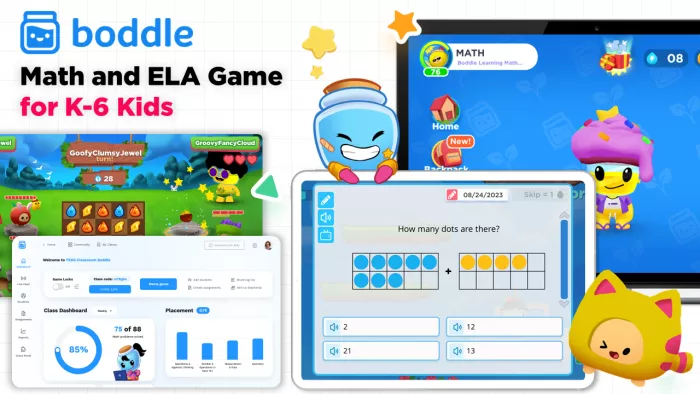
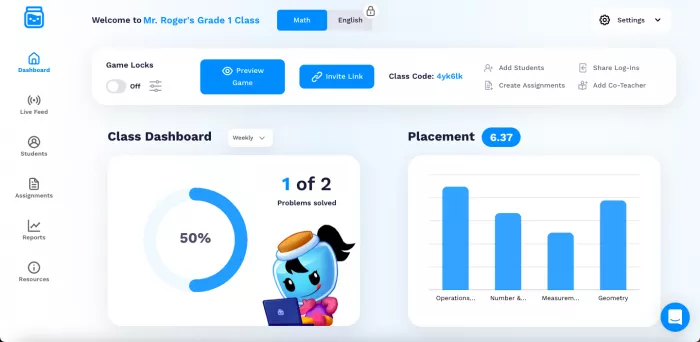
By 9:15, you have a live dashboard showing:
- 6 students who aren't solid on basic facts yet
- 14 who are ready for your planned 2-digit × 1-digit lessons
- 4 who can already handle 2-digit × 2-digit and need challenge
You haven't graded anything. The placement happened while students thought they were playing. Now you can form groups based on actual readiness rather than last year's data or guesswork.
Wednesday, station rotations
Group A works with you on word problems. Group B uses manipulatives. Group C is on Boddle, working through assigned multiplication skills.
While Group C plays, you glance at the live feed on your laptop. Emma, who seemed fine Monday, is at 38% accuracy on regrouping problems. You make a mental note to pull her aside tomorrow.
The key difference from traditional centers: you're getting formative data during independent work, not days later after you've graded worksheets.
Friday check-in
You assign a quick Boddle session covering this week's standards. Students still see it as game time. You see it as a formative assessment that auto-scores itself.
End result: You know exactly which five students need reteaching on partial products before moving on. No papers to mark, no Friday evening at your desk with a red pen.
What Doesn't Change
Boddle won't:
- Teach the initial concept (you still need to explain what multiplication means)
- Run parent-teacher conferences for you (though it gives you better talking points)
- Work well if you assign it and never look at the reports
- Replace your curriculum (it's practice and assessment, not instruction)
The Student Experience (According to Actual Students)
What kids told us they like:
- "It doesn't feel like a test even though I'm answering math questions"
- "I can make my Boddle character look cool"
- "The mini-games between questions are actually fun"
- "I don't feel embarrassed when I get one wrong because no one else sees"
What some kids struggled with:
- "Sometimes I want to just play the games and skip the math" (the eternal tension)
- "My friend has a better character because their parents paid for premium" (cosmetic gap)
- "I get frustrated when questions get really hard" (adaptive difficulty can feel punishing)
The emotional tone for most students: low-stakes engagement. Mistakes don't feel catastrophic, and success comes in small, frequent doses. For math-anxious kids, this matters more than adults often realize.
The Evidence Question
What the Research Actually Shows
Boddle earned ESSA Level III "Promising Evidence" certification based on a year-long study. Here's what that means in practical terms:
What they found:
- Students who used Boddle consistently (2-3 times per week) and maintained reasonable accuracy showed greater math gains on external assessments
- Students reported lower math anxiety after sustained Boddle use
- Teachers found the Learning Gaps Report helped them target instruction more precisely
What it doesn't prove:
- That Boddle works if you just assign it and walk away (the study tracked engaged teachers)
- That it replaces direct instruction (students still needed their regular lessons)
- That every student will love it (engagement varied)
Translation: Boddle is a tool that amplifies good teaching. It won't fix bad teaching or replace absent teaching.
Real Teacher Feedback (Not From Marketing Materials)
From elementary teachers in various districts:
"The live dashboard during stations is genuinely useful. I can see who's stuck without hovering." — 3rd grade teacher, Texas
"My struggling students practice more with Boddle than they ever did with worksheets. That alone makes it worth it." — 2nd grade teacher, California
"The data is great, but I had to train myself to actually check it weekly. It's not automatic magic." — 5th grade teacher, Ohio
"Some of my kids play it at home voluntarily. I've never had a kid volunteer to do extra drill worksheets." — 4th grade teacher, New York
The Money and Access Question
For Teachers: Actually Free
Not "free trial then paywall." Not "free but limited." Completely free for classroom use:
- Full student roster management
- All assignments and skill tracking
- Complete access to dashboards and reports
- No upgrade prompts or feature locks
Schools can pay for district-level analytics tools, but individual teachers don't need to.
For Parents: Free Works, Premium is Optional
Free tier includes:
- All learning content (math and ELA)
- Teacher assignments and progress
- Basic character customization
- Core game features
Premium adds:
- More outfit and character options
- Extra mini-games and quests
- Expanded customization
Honest parent guidance: Start with free. If your child is genuinely engaged and asking to play Boddle at home, premium might boost motivation. But the learning engine is identical—you're paying for cosmetic perks, not better instruction.
Cost: Premium plans typically run $6-10/month or around $60-80/year for one child.
The Decision Framework
Use Boddle if you need:
Problem: Mixed-ability class where differentiation feels impossible
Solution: Adaptive engine adjusts difficulty automatically while you work with small groups
Problem: Hours spent grading basic practice and entering data
Solution: Auto-scored practice with instant dashboards organized by standard
Problem: Students who resist traditional drill work
Solution: Game wrapper makes "do 20 more problems" feel like playtime
Problem: Vague sense of class readiness without concrete data
Solution: Placement logic and skill-by-skill reports show exactly what each student knows
Skip Boddle if you need:
Problem: A complete math curriculum with full lessons
Reality: Boddle is practice and assessment only, not instruction
Problem: Tools for students above grade 6
Reality: Content stops at 6th grade; older students will find it juvenile
Problem: Software that works without teacher engagement
Reality: Best results require weekly data review and instructional adjustments
Problem: Guaranteed engagement for every student
Reality: Most kids like it; some don't connect with the game style
Privacy and Safety (The Non-Corporate Summary)
What parents and teachers need to know:
- COPPA and FERPA compliant (meets federal student privacy laws)
- Ad-free learning environment (revenue is from premium, not advertising)
- Collects: student names, grade level, performance data
- Does NOT sell student data to third parties
- Data deletion available on request
For schools: Review Boddle's Data Privacy Agreement, but the model fits standard K-6 privacy expectations. Most districts approve it quickly.
For parents: If you're comfortable with your child using school-issued learning apps, Boddle's privacy practices are similar or stronger than most.
The Bottom Line
Boddle succeeds where many "educational games" fail: it's genuinely engaging for most elementary students while providing teachers with actionable data they'll actually use.
It works best when:
- Teachers check dashboards at least weekly
- Students use it 2-3 times per week consistently
- It supplements (not replaces) direct instruction
- Families understand premium is optional, not required
It doesn't work when:
- Teachers assign it and ignore the data
- It's positioned as the entire math program
- Students only use it sporadically
- Districts expect instant score jumps without implementation support
Who should try it: Any K–6 teacher drowning in grading who wants more practice time without more marking time, and whose students need differentiation that doesn't require creating three lesson plans.
Who should skip it: Teachers looking for curriculum, middle school educators, or anyone wanting truly hands-off software.
Final Rating: 4.3/5
Why not perfect?
It's practice and assessment, not instruction. The game elements work for most kids but not all. Premium creates a cosmetic gap some parents dislike.
Why 4.3?
For its actual purpose—increasing practice volume and surfacing learning gaps with minimal teacher burden—it's one of the best-designed tools in K-6 math.
Three Questions to Ask Before You Start
Will you realistically check the dashboard weekly?
If no, Boddle becomes expensive busywork. If yes, it becomes useful.
Do your students need more practice opportunities?
If they already do too much drill, adding Boddle won't help. If they need more reps but resist worksheets, it might.
Are you prepared to explain to parents why premium is optional?
Some families will feel pressure when kids compare characters. Have your talking points ready.
If you answered yes to questions 1 and 2, and you're ready for question 3, Boddle is worth a pilot.
Start Here: Week One Implementation Plan
Day 1: Create teacher account, roster students, let them customize characters (10 min)
Day 2: Run first placement session, watch the dashboard populate (15 min)
Day 3: Review dashboard, form 2-3 skill groups based on data (5 min planning)
Day 4: Assign targeted skills to each group, use Boddle as one station (20 min)
Day 5: Check accuracy rates, flag students for follow-up next week (5 min)
Total time investment: About 30 minutes of setup, then 5-10 minutes of weekly dashboard review.
What you eliminate: 2-3 hours of grading and data entry per week.
That's the real trade-off.
Last updated December 2026. Boddle features, pricing, and policies subject to change. This review reflects classroom use in U.S. K-6 settings.

Comments