AutoLinkRush.com: Automatic Backlink Generator Tool (2026)

Rajat Chauhan
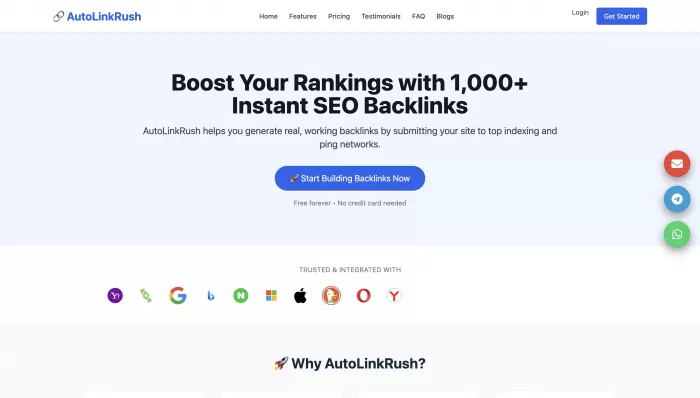
Table of Contents
- AutoLinkRush com Review 2026: Legit or Link Spam?
- AutoLinkRush at a Glance
- The Mechanics: Link Generation in Practice
- Features and Pricing
- Legitimacy: Real Tool or Scam?
- Safety: Where Google's Policy Lands on This
- The Indexing Claim, Examined
- Pros and Cons
- Safer Alternatives That Do the Same Job
- Who Might Still Consider It
- Frequently Asked Questions
- Verdict
AutoLinkRush com Review 2026: Legit or Link Spam?
The short answer
AutoLinkRush is not a scam. It is a real tool that does exactly what it advertises: you paste a URL and a keyword, and it blasts your link across directories, ping services and web 2.0 properties, producing hundreds or thousands of backlinks in minutes. The problem is not whether it works. The problem is that what it does is listed by name in Google's own spam policy.
AutoLinkRush at a Glance
| Type | Automated backlink generator and URL indexer |
| Input required | Target URL plus anchor keyword |
| Output | Bulk links across directories, ping services, web 2.0 and link-exchange networks |
| Speed | Seconds to minutes |
| Pricing model | Free tier with daily limits, plus one-time paid packages |
| Install needed | None, browser based |
| Skill needed | None |
| Primary audience | New bloggers and small site owners, heavily India-based |
| Google policy status | Matches a practice named directly in Google's link spam policy |
The Mechanics: Link Generation in Practice
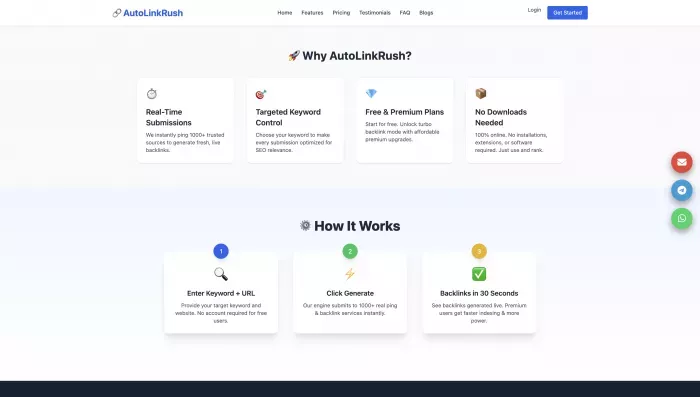
The workflow is deliberately trivial. Open the site, paste your page URL, type the keyword you want to rank for, click generate. The system pushes your URL into a submission queue that distributes it across a network of directories, bookmark sites, RSS ping services and link-exchange participants, then pings search engines to encourage crawling.
Some listings describe an AI matching layer that pairs participating sites by niche and anchor preference before generating reciprocal links. That detail matters more than it first appears, and I come back to it below.
Two things are worth noticing about this design. You never see the sites your links land on before they are created, and you have no ability to approve, decline or remove an individual placement. You are handing over anchor text and a destination URL and receiving a count back.
That is the entire product. There is no outreach, no editorial placement, no relationship with a publisher. The count is the deliverable.
Features and Pricing
Credit where due: for what it is, the execution is clean.
- Free tier. Genuinely free, capped per day, enough to test the mechanism.
- One-time payments. No subscription, which is unusual in SEO tooling and clearly designed for a price-sensitive market.
- Bulk generation. Marketing materials reference 1000+ links per campaign.
- Dashboard. Paid tiers show link counts and campaign status.
- Anchor control. You choose the keyword used across the batch.
- Indexing pings. Submissions to indexing services to accelerate discovery.
The interface is beginner-friendly and there is nothing deceptive in the purchase flow. If your question is "will I be charged and receive nothing", the answer is no.
Legitimacy: Real Tool or Scam?
Separating these two questions is the whole point of this review, because most coverage blurs them.
Is it a scam? No. There is no evidence of payment fraud, phishing or bait-and-switch. It runs in the browser, it delivers link counts, and the free tier lets you verify that before spending anything. On the narrow question of "does this company take money and disappear", it clears the bar.
Is it legitimate SEO? That is a different question, and the answer is no.
The distinction matters because a lot of readers arrive here having typed "scam" into Google, get told "not a scam", and leave with the wrong conclusion. A tool can be entirely honest about what it does while what it does is the thing that damages your site.
Safety: Where Google's Policy Lands on This
Here is the passage every other review of this tool leaves out. Google's spam policies define link spam as creating links primarily to manipulate rankings, and list examples including buying or selling links for ranking purposes, excessive link exchanges or partner pages existing purely for cross-linking, and using automated programs or services to create links to your site.
Read that last item next to the product description. This is not a grey area or an interpretation. Automated link creation is named, specifically, as an example of link spam. If the tool also operates a reciprocal exchange between participants, it matches a second item on the same list.
Now the part that changes the risk calculation entirely. The common advice, implied across every competing review, is to try it and clean up later if things go wrong. Google's own documentation says that will not work: in the case of a link spam update, making changes might not generate an improvement, because when their systems remove the effects spammy links may have, any ranking benefit those links previously generated is lost and cannot be regained.
That means the upside is temporary by design and the cleanup does not restore you to where you started. You are not making a reversible bet.
The honest framing. Google mostly ignores links like these rather than actively punishing you, so the realistic outcome for most users is not a dramatic penalty. It is that you spend money, generate thousands of links, and nothing happens. The downside case, a contaminated profile on a site you later want to grow properly, is less likely but far more expensive.
One further observation, and it is visible without leaving the search results. Guest posts on autolinkrush.com are openly sold through third-party marketplaces for around $42 a placement. A site that sells links pointing out is operating inside the same economy it invites you to join. Draw your own conclusion, but it is a relevant data point about how the network sustains itself.
The Indexing Claim, Examined
The strongest argument in the tool's favour is indexing rather than ranking. New pages sometimes take days or weeks to get crawled, and pinging services can nudge discovery along.
This is partly true and mostly obsolete. If your page is genuinely not being discovered, the fix is almost always structural: a missing or stale XML sitemap, a robots.txt block, no internal links pointing to the page, or a thin page Google chose not to prioritise. Firing a thousand directory links at it addresses none of those.
Free, sanctioned alternatives that solve the actual problem:
- Google Search Console URL Inspection, then Request Indexing. Direct, free, official.
- Submit a clean XML sitemap and confirm it processes without errors.
- Link the new page from an existing indexed page on your own site. This is the single most reliable accelerator and costs nothing.
- Check the Pages report in Search Console for the exclusion reason before assuming it is a discovery problem.
If those four do not get a page indexed, the page itself is the issue, and no link blast fixes that.
Pros and Cons
Pros
- Free tier lets you verify the mechanism at zero cost
- One-time pricing rather than a subscription
- Genuinely simple, no technical knowledge required
- Fast, results within minutes
- No install, works from any device
- No evidence of billing fraud or deceptive practices
Cons
- Matches a practice named explicitly in Google's link spam policy
- You cannot see or vet the sites your links land on
- Anchor text repeated at scale creates an obvious detectable footprint
- Any ranking benefit is, by Google's own account, unrecoverable once discounted
- Reciprocal exchange models compound the policy problem
- No transparency about the network you are joining
- Solves an indexing problem that free official tools solve better
Safer Alternatives That Do the Same Job
If the underlying goal is faster discovery and early traction on a new site, these get you there without the policy exposure.
| Goal | Better option | Cost |
|---|---|---|
| Get a new page indexed | Search Console URL Inspection plus internal linking | Free |
| Find real link opportunities | Ahrefs or Semrush competitor backlink gap analysis | Paid tool, sanctioned method |
| Build early citations | Genuine business directories relevant to your niche, submitted manually | Free to low |
| Earn editorial links | Original data, tools or research others cite | Time |
| Audit existing damage | Search Console links report plus a disavow file if needed | Free |
None of these produce a thousand links in ten minutes. That is the actual trade you are making, and it is worth being clear-eyed that the thousand links were never worth much to begin with.
Who Might Still Consider It
I would not recommend it for a site you care about. There is one narrow case where it is defensible: a genuinely throwaway test domain, where you want to observe how Google treats bulk automated links, and you accept that the domain is burned afterwards. That is an experiment, not a strategy.
For a real blog, a client site, an affiliate project or a business site, the calculation does not work. You are risking an asset with a long payback period to accelerate a metric that stopped correlating with rankings years ago.
Frequently Asked Questions
Is AutoLinkRush com legit?
It is a real, functioning tool rather than a scam. It delivers the backlink counts it advertises and there is no evidence of payment fraud. Legitimate as a business is not the same as safe for SEO, and on the second question it matches a practice Google's spam policy names directly.
Is AutoLinkRush safe for SEO?
No. Google's spam policies list using automated programs or services to create links to your site as an example of link spam. That is a direct description of what this tool does. The most likely outcome is that the links are ignored and you see no benefit; the worse outcome is a contaminated backlink profile on a site you later want to grow.
Will AutoLinkRush get my site penalised?
A manual penalty is unlikely for most users. Google typically discounts spammy links rather than punishing sites for them. The realistic downside is wasted money and no movement, plus a link profile you may need to disavow later.
Does AutoLinkRush actually help with indexing?
Marginally at best, and only when discovery was the real problem. If a page is not indexed, the cause is usually a sitemap issue, a robots block, no internal links, or thin content. Search Console URL Inspection and an internal link from an indexed page solve it faster and for free.
Is AutoLinkRush free?
There is a free tier with daily limits, plus paid one-time packages rather than a subscription. You can test the mechanism without spending anything.
Can I remove AutoLinkRush backlinks later?
Not directly, since you never controlled the placements. Your only option is a disavow file in Search Console. Note that Google states that once its systems discount spammy links, any ranking benefit they generated is lost and cannot be recovered, so cleanup does not return you to your starting position.
What should I use instead of AutoLinkRush?
For indexing, use Search Console URL Inspection and internal linking. For link acquisition, use a backlink gap analysis in Ahrefs or Semrush to find sites already linking to competitors, then approach them directly. Slower, and the links actually count.
Verdict
AutoLinkRush is an honest product built to do a dishonest job. It is transparent about its pricing, delivers what it promises, and has none of the hallmarks of a scam. Every review calling it legit is correct on that narrow point.
It is also an automated link generator, and Google's spam policy names automated link generation as link spam in plain language. There is no clever usage pattern that resolves that, no safe volume, no combination with good content that makes the underlying method acceptable. The tool works exactly as designed, and the design is the problem.
If you are a new blogger frustrated that nothing is indexing, the honest advice is unglamorous: submit a proper sitemap, request indexing in Search Console, link the page from somewhere on your own site that already ranks, and put the money toward one genuinely useful piece of content instead.
Rating: 3.5 out of 10. Functional, cheap, honestly sold, and pointed squarely at the one thing Google has spent a decade learning to ignore.
Want the publication-ready HTML in the SoftwareCurio design system, plus a landscape thumbnail like the checksum one? Say the word and I'll build both.

Comments