AutoLinkRush.com Review 2026: What It Really Does, How It Works, and Is It Safe for SEO?

Rajat Chauhan
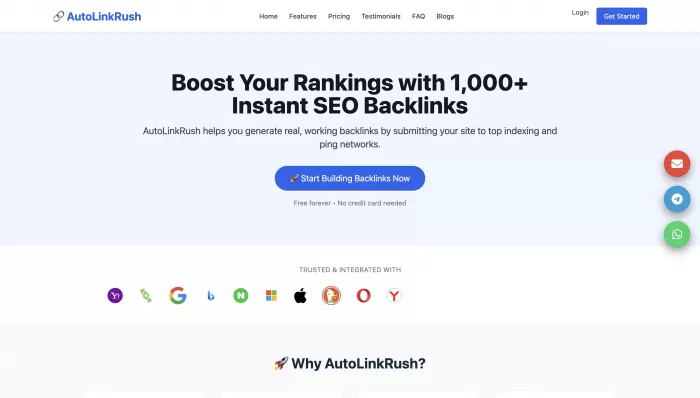
Table of Contents
- What Is AutoLinkRush.com?
- How AutoLinkRush Actually Works: The Ping Mechanism
- Key Features of AutoLinkRush.com
- How to Use AutoLinkRush: Step by Step
- Is AutoLinkRush Safe for SEO?
- Pros and Cons
- AutoLinkRush Pricing: What It Signals
- SEO Scorecard
- Best Alternatives for Real Backlink Growth
- Frequently Asked Questions
- Final Verdict
Thousands of bloggers search for AutoLinkRush.com every week, drawn by a promise that sounds irresistible: over 1,000 backlinks generated in minutes, for free. Building backlinks through outreach and guest posting takes months. AutoLinkRush claims to shortcut the entire process with a single URL submission.
Before you hit submit, there is something critical you need to understand. What this tool generates is not what most people think. The difference between what AutoLinkRush markets and what it delivers is the difference between indexing and ranking, between a crawl reference and a genuine backlink, between a shortcut and a strategy.
This guide breaks down how AutoLinkRush works under the hood, what its backlinks really are, how Google treats them, and whether there is any legitimate use case for this tool.
What Is AutoLinkRush.com?
AutoLinkRush.com is a web-based tool that submits your website URL and a target keyword to a large network of RSS ping servers, feed aggregators, and legacy indexing endpoints. No software download is required. Users register, enter their URL and keyword, and the system pings hundreds of endpoints on their behalf.
The tool markets itself as a backlink generator capable of creating 1,000 or more backlinks instantly. In practice, it functions as a ping-based URL propagation service. It notifies endpoints that your URL exists, which can trigger crawlers to discover and potentially index your page.
AutoLinkRush offers a free tier along with one-time paid plans up to approximately fifteen dollars for lifetime access. No subscription required.
How AutoLinkRush Actually Works: The Ping Mechanism
When you submit your URL, the tool sends XML-RPC ping requests to publicly available ping servers, the same type that WordPress uses to notify search engines of new content. The ping says: "This URL exists. Come crawl it."
Feed aggregators and RSS directories receiving these pings may create a temporary reference or log entry containing your URL. AutoLinkRush counts each of these as a "backlink."
The critical distinction: these are machine-generated entries in server logs and aggregator databases, not editorial links placed within relevant content by someone who reviewed your page. Google's algorithms distinguish between these two types of references and treat them very differently.
What "1,000+ Backlinks" Actually Means
AutoLinkRush reports the number of ping endpoints that acknowledged your URL submission. Each server log entry counts as one backlink. These references technically exist, but the vast majority carry no link equity, no authority transfer, and no ranking signal Google considers meaningful.
Think of it this way: if someone writes your phone number on 1,000 bathroom walls, it technically appears in 1,000 locations. But none carry the credibility of being listed in a professional directory or recommended by a trusted colleague. The quantity is real. The value is not.
Indexing vs. Ranking: The Critical Difference
This is the most important concept for anyone evaluating AutoLinkRush.
Indexing is Google discovering your page and adding it to its database. A page must be indexed to appear in search results. Pinging can accelerate this discovery, especially for new websites with few existing links.
Ranking is where your page appears in results for a given query. It depends on content quality, topical relevance, user experience, site authority, and backlink quality. Ping-generated references do not influence ranking.
AutoLinkRush can potentially help with indexing. It does not help with ranking. Confusing these is the number one mistake users make with this tool. For faster indexing, Google Search Console offers a more reliable, officially supported method.
Key Features of AutoLinkRush.com
| Feature | Description | Practical Value |
|---|---|---|
| Automated URL submission | Pings 1,000+ endpoints with your URL and keyword | Saves time compared to manual pinging |
| Keyword targeting | Associates a keyword with your URL in ping requests | Minimal SEO impact since pings are not anchor text links |
| Web-based platform | No download or installation required | Accessible from any browser |
| Campaign management | Submit and track multiple URLs | Useful for multi-site users |
| Dashboard reporting | Displays generated "backlinks" count | Visual confirmation but may overstate actual value |
| One-time pricing | Free tier plus paid plans up to fifteen dollars | Low financial risk |
How to Use AutoLinkRush: Step by Step
- Navigate to autolinkrush.com and click the registration link.
- Create an account with your email and password.
- Log in to the dashboard.
- Enter your target page URL (specific page, not just homepage).
- Enter your target keyword.
- Start the submission process.
- Monitor the dashboard as it reports completed submissions.
- Check Google Search Console over the following days to see if your URL has been crawled or indexed.
Do not expect ranking changes. If your page was not previously indexed, you may see it appear in Google's index within days, though Google Search Console achieves the same result more reliably.
Is AutoLinkRush Safe for SEO?
This question deserves nuance rather than a simple yes or no.
How Google Treats Mass-Pinged Links
Google deploys two major safeguards against artificial link manipulation:
Penguin, now part of Google's core algorithm, identifies and devalues unnatural link patterns. Mass-generated links from low-quality, irrelevant sources are exactly what Penguin targets. It typically ignores rather than penalizes these links. They pass no value.
SpamBrain, Google's AI-powered spam detection system, identifies link spam at scale. Automated link generation is a known pattern SpamBrain recognizes and disregards.
For most users, AutoLinkRush links are simply ignored by Google. They neither help nor hurt. However, the risk profile changes based on your use case.
Risk Assessment by Use Case
| Use Case | Risk Level | Explanation |
|---|---|---|
| Personal blog with no commercial value | Low | Minimal consequences if links are ignored |
| New site to trigger initial indexing | Low to Moderate | Google Search Console is safer |
| Client or business website | High | Reputational risk and algorithmic scrutiny |
| E-commerce or money page | High | Google applies heightened YMYL scrutiny |
| Tier-2 links to boost other backlinks | Moderate | Grey-hat tactic with added complexity |
| Running repeatedly on the same URL | Moderate to High | Unnatural link velocity may trigger flags |
When to Use It
- Brand new website with zero backlinks needing basic indexing (though Google Search Console is better).
- Tier-2 link building to get tier-1 backlinks indexed (grey-hat, accepted risk only).
- SEO experiments on test domains where you accept devaluation risk.
When to Avoid It
- Any revenue-generating or business website.
- Client websites tied to your professional reputation.
- YMYL categories: health, finance, legal.
- When you need ranking improvements, not just indexing.
Pros and Cons
Advantages:
- Free to start, no credit card required.
- Simple interface requiring no technical knowledge.
- Can trigger faster URL discovery for new pages.
- No installation needed.
- Low financial risk.
Disadvantages:
- Generated "backlinks" carry no meaningful ranking value.
- "1,000+ backlinks" framing is misleading to beginners.
- No verifiable company information or business registration.
- Support via Gmail, not a business domain.
- Anonymous, unverifiable testimonials.
- Gambling-related links found in site footer raise trust concerns.
- No published refund policy.
- No independent case studies showing ranking improvements.
AutoLinkRush Pricing: What It Signals
Free access with optional one-time payments up to fifteen dollars for lifetime access.
Tools providing editorial outreach or AI-powered prospecting charge monthly fees in the hundreds because they involve human labor and quality control. A tool priced at zero to fifteen dollars for lifetime access signals no human review, no editorial quality control, and no ongoing oversight. This does not make it fraudulent, but it confirms its nature as an automated ping service, not a professional link building solution.
SEO Scorecard
| Factor | Rating (1-10) | Notes |
|---|---|---|
| Backlink quality | 1 | Machine-generated ping references |
| Ranking impact | 1 | No evidence of ranking improvement |
| Indexing utility | 5 | Can trigger URL discovery |
| Ease of use | 9 | Simple, no technical skills needed |
| Transparency | 2 | No company info, Gmail support |
| Google safety | 4 | Links typically ignored, grey-hat risk |
| Value for money | 5 | Free tier, but limited to indexing |
| Trustworthiness | 3 | Multiple transparency red flags |
Overall: 3.75 out of 10. Not a scam, but marketing significantly overstates SEO value.
Best Alternatives for Real Backlink Growth
| Tool or Method | Type | Cost | Best For |
|---|---|---|---|
| Google Search Console | Official indexing tool | Free | Getting pages indexed safely |
| Ahrefs | Backlink analysis | From $99/month | Finding link opportunities |
| SEMrush | Full SEO suite | From $119/month | Link gap analysis and outreach |
| Rankloop.io | AI outreach automation | Paid | Scaled editorial outreach |
| Manual guest posting | Editorial outreach | Free (time) | Highest quality, sustainable links |
| HARO / Connectively | Journalist sourcing | Free | High authority editorial links |
For indexing specifically, Google Search Console is objectively superior: it is official, submits directly to Google's index pipeline, confirms indexing status, and carries zero algorithmic risk.
Frequently Asked Questions
Is AutoLinkRush free?
Yes. A free tier is available. Paid plans are one-time purchases up to approximately fifteen dollars.
Does it improve Google rankings?
No verified evidence exists. Generated references are designed to be identified and disregarded by Google's algorithms.
Can it get my site penalized?
Usually Google ignores the links rather than penalizing. However, repeated or large-scale use can create unnatural patterns attracting algorithmic scrutiny, especially for commercial sites.
Is it a scam?
Not in the traditional sense. It performs the function described technically. However, calling ping references "backlinks" and implying ranking improvement is misleading.
Who created it?
No publicly identified company, business registration, founder, or business address. Support runs through Gmail.
Are the backlinks real?
URL references exist in server logs and aggregator databases. They are not editorial backlinks and carry no link equity or ranking value.
Should I use it for client websites?
No. The grey-hat classification and reputational risk make it unsuitable for professional SEO work.
What should I use instead?
Google Search Console for indexing. Manual outreach, guest posting, or tools like Ahrefs and SEMrush for genuine backlink building.
Is AutoLinkRush better than manual link building?
No. Manual link building produces editorial, contextually relevant backlinks from authoritative domains. AutoLinkRush produces automated references that are categorically different in quality and impact.
Final Verdict
AutoLinkRush.com is a functional ping service that does what its architecture is built for: submit your URL to a large number of endpoints quickly. For that narrow purpose, it works.
The problem is not that the tool is broken. The problem is that its marketing frames ping references as "backlinks" and implies they improve rankings. They do not. Google's algorithms are specifically designed to disregard this type of automated signal.
If you need faster indexing, Google Search Console is free, official, and risk-free. If you need better rankings, no automated ping service will deliver that. You need quality content and genuine backlinks earned through relevance, value, and relationship building.
AutoLinkRush fills a space created by the gap between how difficult real SEO is and how easy people wish it were. Understanding that gap is the first step toward a strategy that actually works.

Comments