7 Top AI Engineering Intelligence Platforms of 2026

Parveen Verma

Table of Contents
- What AI Actually Needs to Understand About Engineering Systems
- The 7 Top AI Engineering Intelligence Platforms of 2026
- Different Types of AI Engineering Intelligence
- Where AI Engineering Intelligence Has the Biggest Strategic Impact
- How AI Changes Engineering Leadership Decision-Making
- Common Mistakes When Evaluating AI Engineering Intelligence Platforms
- FAQs
Engineering organizations are producing more data than ever before, yet decision-making has not become proportionally easier. Dashboards have multiplied, metrics have become more sophisticated, and reporting cycles have accelerated. What has not changed is the fundamental difficulty of interpreting engineering systems. Performance issues rarely appear as a single failing metric. They emerge as patterns: subtle shifts in throughput, increasing coordination overhead, planning instability, architectural drag, or workload concentration. These patterns are difficult to detect without a modeling layer capable of correlating signals across domains.
What AI Actually Needs to Understand About Engineering Systems
To understand why AI is becoming central to Engineering Intelligence, it is necessary to understand what makes engineering organizations difficult to model in the first place. Engineering work is not linear, teams are not independent, architecture influences throughput, and planning accuracy often predicts delivery stability more reliably than activity metrics.
Work Is Not Linear
Software delivery does not behave like a manufacturing line. Work expands and contracts based on dependencies, unknowns, technical debt, and external requirements. AI models that assume linear progress often produce misleading conclusions. Effective AI Engineering Intelligence platforms account for variability and volatility rather than smoothing them out.
Teams Are Not Independent
Most delivery delays are not caused by individual team inefficiency but by coordination overhead between teams. Shared services, architectural dependencies, and review bottlenecks create invisible queues that slow delivery without appearing in team-level metrics. AI must be able to detect these dependency networks and identify where coordination cost is accumulating.
Architecture Influences Throughput
Architecture is one of the most overlooked drivers of delivery performance. Highly coupled systems reduce throughput regardless of team productivity. AI models that correlate architectural concentration with delivery patterns can reveal structural constraints that process optimization alone cannot fix.
Planning Accuracy Predicts Delivery Stability
Organizations that consistently overcommit tend to experience volatility, context switching, and delivery instability. AI can detect divergence between planned and delivered work, identifying planning realism as a key performance driver. In many cases, improving planning discipline has more impact than increasing engineering output.
These realities explain why AI Engineering Intelligence must operate across multiple domains simultaneously. It must interpret relationships, not just measure activity.
The 7 Top AI Engineering Intelligence Platforms of 2026
1. Milestone
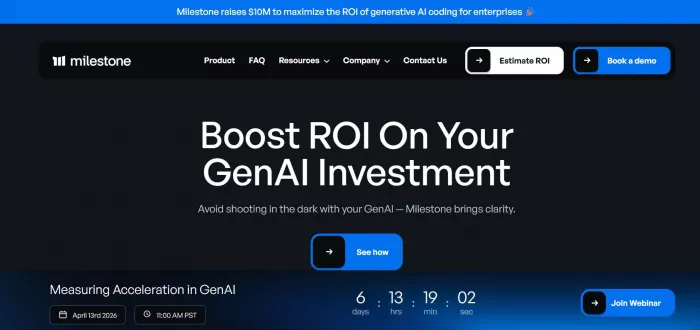
Milestone represents one of the most advanced implementations of AI Engineering Intelligence because its modeling approach begins at the system level rather than the metric level. Instead of aggregating development data into dashboards, the platform constructs a dynamic model of engineering behavior that incorporates delivery signals, operational signals, and organizational structure.
The platform’s AI layer is designed to detect systemic patterns rather than isolated anomalies. For example, a change in deployment frequency might be analyzed in relation to review load, ownership distribution, and incident patterns rather than treated as an independent metric. This type of cross-domain correlation allows the system to surface relationships that would otherwise remain hidden behind normal-looking dashboards.
Another important aspect of Milestone’s AI approach is its focus on engineering health rather than short-term output. Many organizations inadvertently optimize for visible productivity while accumulating structural fragility. Milestone’s models track sustainability indicators such as workload distribution, coordination overhead, and delivery volatility, allowing leadership to see whether performance improvements are stable or temporary.
The platform also emphasizes interpretability. AI-generated signals are presented as decision-relevant narratives rather than abstract scores. This is particularly important at the executive level, where insight must translate into staffing decisions, architectural investment, or planning adjustments.
Key capabilities:
1. AI-driven system-level engineering modeling
2. Cross-domain signal correlation across delivery, operations, and structure
3. Predictive detection of delivery volatility and sustainability risk
4. Executive-level interpretation and decision support
2. Oobeya
Oobeya applies AI Engineering Intelligence primarily at the portfolio and value stream level. Its platform focuses on understanding how engineering initiatives align across programs and how dependencies between teams affect execution risk.
In large organizations, strategic initiatives often involve multiple teams working across shared services and infrastructure. Delays rarely originate from a single team; they emerge from dependency chains. Oobeya’s AI layer maps these relationships and identifies where coordination risk is accumulating across the portfolio.
Rather than focusing on granular code-level metrics, the platform emphasizes initiative progress, dependency networks, and alignment between planned work and strategic objectives. This makes it particularly relevant in enterprise environments where governance, planning cycles, and cross-program coordination play a major role in delivery outcomes.
Oobeya’s strength lies in its ability to translate engineering activity into portfolio-level visibility. AI models detect patterns such as recurring dependency delays, initiative misalignment, or execution bottlenecks that affect multiple teams simultaneously.
Key capabilities:
1. AI-supported portfolio and value stream visibility
2. Cross-team dependency modeling
3. Initiative alignment and execution tracking
4. Portfolio-level risk detection
3. Athenian
Athenian approaches AI Engineering Intelligence through analytical depth and pattern detection across large datasets. Its platform provides detailed visibility into engineering workflows, contribution patterns, and performance trends over time.
The AI component within Athenian is particularly strong in segmentation and longitudinal analysis. Organizations can examine how performance evolves across teams, repositories, and time periods, allowing them to identify subtle shifts that may not be visible in aggregate metrics. For example, gradual increases in review latency or code churn may indicate emerging coordination or quality issues.
Athenian is especially valuable in organizations with strong data literacy, where leaders and engineering operations teams are comfortable exploring complex datasets and drawing conclusions from analytical models. Rather than abstracting insights into simplified narratives, the platform provides the analytical tools necessary to investigate engineering behavior in detail.
This analytical depth makes Athenian a powerful tool for organizations that want to understand not just what is happening, but how patterns evolve over time and across teams.
Key capabilities:
1. AI-supported workflow and contribution analytics
2. Longitudinal engineering performance modeling
3. Comparative analysis across teams and repositories
4. High-resolution segmentation and pattern detection
4. Plandek
Plandek’s AI capabilities focus on delivery predictability and flow stability. The platform analyzes how work moves through the system and how reliably organizations meet their delivery commitments. While many tools emphasize throughput, Plandek emphasizes variance and predictability, which are often more important indicators of delivery health.
Its AI models analyze historical flow patterns and identify deviations from expected behavior. These deviations may signal overcommitment, coordination bottlenecks, or planning instability. By detecting these patterns early, the platform helps organizations stabilize delivery performance and improve forecasting accuracy.
One of Plandek’s strengths is its focus on planning realism. Organizations often measure delivery speed without examining whether planning assumptions are realistic. Plandek’s modeling highlights divergence between planned and delivered work, which is often a leading indicator of delivery risk.
The platform is particularly useful in organizations where commitment reliability and forecasting accuracy are strategic priorities. Instead of optimizing for raw throughput, it helps organizations reduce delivery volatility.
Key capabilities:
1. AI-based flow and throughput modeling
2. Predictive detection of delivery variance
3. Planning deviation and forecasting analysis
4. Trend acceleration and volatility monitoring
5. Allstacks
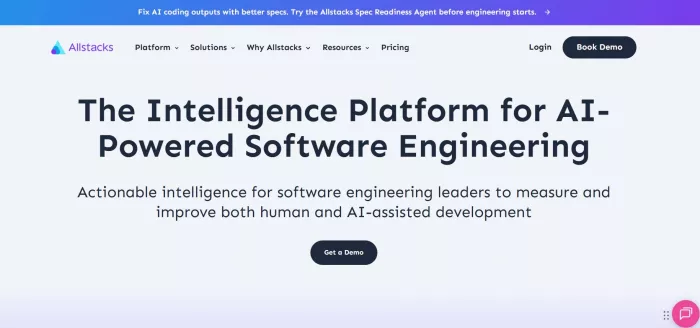
Allstacks focuses on capacity modeling and execution feasibility. Its AI layer analyzes how resource allocation, workload distribution, and planning assumptions influence delivery outcomes. This perspective is particularly useful in organizations where resource constraints and staffing decisions significantly affect delivery timelines.
The platform correlates effort allocation with delivery results, helping leadership understand whether execution challenges stem from performance issues or structural capacity limits. This distinction is important because many delivery problems are caused by unrealistic planning rather than engineering inefficiency.
Allstacks also analyzes execution patterns over time, allowing organizations to see whether capacity assumptions are improving or deteriorating. This helps leadership make informed decisions about hiring, staffing, and initiative prioritization.
Rather than focusing on code-level analytics, Allstacks provides intelligence around execution feasibility and planning realism, which are often the root causes of delivery instability.
Key capabilities:
1. AI-assisted capacity and resource modeling
2. Effort-to-outcome correlation analysis
3. Execution feasibility and planning realism insight
4. Delivery trend and capacity forecasting
6. Sleuth
Sleuth focuses on delivery and deployment patterns, providing AI-driven insight into release behavior and stability trends. Its platform analyzes deployment frequency, change failure rates, and incident patterns to identify long-term delivery trends.
While Sleuth does not attempt full system modeling, it provides valuable visibility into release health and delivery consistency. Its AI models detect patterns such as increasing rollback frequency or declining deployment stability, which may indicate underlying process or quality issues.
Sleuth is particularly useful in organizations where release stability is a primary concern and where leadership wants visibility into how process changes affect delivery outcomes over time.
Key capabilities:
1. AI-driven deployment and release trend analysis
2. Stability and reliability pattern detection
3. Historical delivery performance modeling
4. Release health monitoring
7. Swarmia
Swarmia focuses on developer experience, collaboration patterns, and workflow efficiency. Its AI analytics examine how work is distributed across teams, how collaboration patterns evolve, and where coordination friction affects productivity.
One of the most important aspects of developer experience is workload balance. Sustained workload concentration on specific individuals or teams often leads to burnout and delivery instability. Swarmia’s analytics highlight these patterns, helping organizations address sustainability issues before they affect delivery performance.
Swarmia also provides insight into workflow interruptions and collaboration overhead, which are often invisible in traditional productivity metrics but significantly affect engineering performance.
Key capabilities:
1. Developer experience and workflow analytics
2. Workload distribution and collaboration visibility
3. Coordination friction detection
4. Team-level performance insight
Different Types of AI Engineering Intelligence
Not all AI Engineering Intelligence platforms are solving the same problem, even if they are often grouped into the same category. One of the most common mistakes organizations make is evaluating these tools as if they were interchangeable. In reality, they operate at different layers of the engineering system, and each layer answers a different leadership question.
Understanding these layers makes the category much easier to navigate.
System-Level Intelligence
System-level platforms attempt to model engineering as a dynamic system. They focus on how teams, architecture, planning, and delivery interact over time rather than analyzing isolated workflows.
These platforms help answer questions such as:
● Where is delivery risk accumulating across the organization?
● Are certain teams becoming structural bottlenecks?
● Is architecture limiting throughput?
● Is workload distribution sustainable?
This layer is the closest to what can be described as true Engineering Intelligence rather than analytics.
Portfolio-Level Intelligence
Portfolio-focused platforms operate at a higher level of abstraction. Their main concern is alignment and execution across strategic initiatives.
They help organizations understand:
● Whether engineering work aligns with strategic priorities
● Where cross-team dependencies threaten delivery timelines
● Which initiatives carry the highest execution risk
● How delays propagate across programs
This perspective is especially relevant in large enterprises managing multiple concurrent initiatives.
Delivery Intelligence
Delivery-focused platforms concentrate on execution stability and predictability. Their goal is not to model the entire system but to understand how work moves through it.
They typically focus on:
● Flow efficiency
● Throughput stability
● Planning accuracy
● Delivery variance
For organizations where commitment reliability is a primary concern, this layer can provide immediate value.
Capacity Intelligence
Capacity-focused platforms analyze whether workload, staffing, and planning assumptions are aligned. Many delivery problems are not caused by slow teams but by unrealistic planning or structural capacity limits.
These platforms help leadership understand:
● Whether current staffing supports planned work
● Whether execution problems stem from overload
● Whether delivery expectations are realistic
Developer Experience Intelligence
This layer focuses on collaboration patterns, workload distribution, and coordination friction. These signals are often early indicators of burnout, knowledge silos, or review bottlenecks.
Typical insights include:
● Workload concentration
● Collaboration overhead
● Review burden distribution
● Interruption patterns
Most platforms in the category specialize in one or two of these layers. The key is identifying which layer corresponds to the organization’s primary constraint.
Where AI Engineering Intelligence Has the Biggest Strategic Impact
AI Engineering Intelligence has the greatest strategic impact when organizations reach a level of complexity where intuition no longer scales. At that point, leaders can see metrics, but they cannot easily see patterns.
This usually happens when:
● The organization grows beyond a few teams
● Multiple teams work on shared services
● Architecture becomes interdependent
● Delivery commitments become business-critical
● Planning cycles involve multiple stakeholders
At this stage, problems rarely appear as a single failing metric. Instead, organizations experience symptoms such as:
● Delivery becoming less predictable
● Teams feeling overloaded despite increased hiring
● Incidents increasing without obvious root causes
● Planning cycles becoming unreliable
● Coordination overhead increasing
These are systemic issues. They cannot be solved by optimizing a single metric or a single team.
AI Engineering Intelligence helps by identifying patterns behind these symptoms, such as:
● Increasing dependency networks
● Ownership concentration in critical components
● Planning instability across teams
● Throughput volatility patterns
● Workload imbalance trends
This type of insight changes how organizations make decisions.
Instead of reacting to problems after they appear, leadership can intervene earlier by adjusting structure, planning, or architecture.
How AI Changes Engineering Leadership Decision-Making
One of the most important but least discussed impacts of AI Engineering Intelligence is how it changes leadership conversations.
Without system-level insight, leadership discussions often revolve around isolated metrics:
● Why did cycle time increase?
● Why did this team miss a deadline?
● Why did deployment frequency drop?
● Why did incident count increase?
These questions are reactive and local. They focus on symptoms.
When organizations adopt Engineering Intelligence, the conversation shifts toward systemic questions:
● Where is coordination complexity increasing?
● Which parts of the system are becoming bottlenecks?
● Is planning realism declining across the organization?
● Is architecture constraining delivery speed?
● Are we scaling sustainably or accumulating fragility?
This shift is significant. It moves leadership from metric management to system management.
AI does not replace leadership judgment, but it changes the quality of information available for decision-making. Leaders spend less time interpreting dashboards and more time making structural decisions.
Common Mistakes When Evaluating AI Engineering Intelligence Platforms
Because this category is relatively new, many organizations evaluate these platforms incorrectly. There are several recurring mistakes.
Mistake 1: Choosing Based on Dashboards
Visualization quality is easy to evaluate, but it is not the main value of these platforms. A platform may have beautiful dashboards and still provide little real intelligence.
The key question should be:
Does the platform detect patterns that would otherwise remain invisible?
Mistake 2: Focusing on Metric Quantity
More metrics do not necessarily produce more insight. In fact, too many metrics often increase noise and reduce clarity.
What matters is not how many metrics the platform tracks, but how it correlates them.
Mistake 3: Ignoring Organizational Context
Different organizations have different constraints:
● Enterprises often struggle with portfolio coordination
● Scale-ups often struggle with coordination complexity
● Product companies often struggle with delivery predictability
● Platform companies often struggle with architectural constraints
Choosing a platform without understanding the organization’s main constraint leads to poor adoption.
Mistake 4: Underestimating Interpretability
If leadership cannot understand why a platform is flagging a risk, trust erodes quickly. Explainability is critical in this category.
FAQs
What problems does AI Engineering Intelligence actually solve?
AI Engineering Intelligence helps organizations understand systemic behavior in complex engineering environments. Instead of focusing on individual metrics, it identifies patterns related to delivery stability, coordination overhead, planning realism, and workload distribution. Its primary value lies in detecting structural risks and performance constraints that are difficult to identify through manual analysis.
Can AI detect engineering risk before traditional metrics change?
In many cases, yes. AI models can detect early indicators such as volatility patterns, planning deviation, ownership concentration, and coordination bottlenecks. These signals often appear before traditional performance metrics deteriorate, allowing organizations to intervene earlier and avoid larger disruptions.
How much historical data is required?
Most platforms require several months of historical data to establish baseline patterns. However, useful insights can often emerge earlier if the platform integrates data across multiple systems such as repositories, planning tools, and CI/CD pipelines.
Do smaller teams need AI Engineering Intelligence?
Smaller teams with minimal dependencies may not require system-level modeling. The value of AI Engineering Intelligence increases significantly as organizations grow and coordination complexity becomes a limiting factor.
What is the difference between AI analytics and AI intelligence?
AI analytics analyzes metrics and trends. AI intelligence models relationships between metrics, organizational structure, and delivery outcomes to generate decision-relevant insight. The difference lies in interpretation rather than measurement.

Comments