A Critical Look at BarberGPT AI and Its Real Capabilities in Hairstyle Simulation

Shubham Sharma
Table of Contents
- What BarberGPT is in practical terms
- How the system is architected
- Workflow and ease of use
- Pricing and commercial model
- Output characteristics and realistic expectations
- Privacy and data handling
- What Reviews Say About BarberGPT
- Market placement and alternatives (compact comparison)
- Practical guidance for prospective users
- Bottom line
What BarberGPT is in practical terms
BarberGPT is a narrowly focused AI service designed to generate photorealistic previews of men’s hairstyles using user-uploaded photos. The platform functions primarily as a browser-based visual try-on tool that allows users to experiment with different haircut styles before making real-world grooming decisions. This review evaluates the service through measurable aspects such as interface design, workflow efficiency, pricing structure, output quality, privacy considerations, and overall market positioning. The analysis takes a deliberately neutral and clinical approach, avoiding anecdotal claims or unverified user experiences and instead focusing on the platform’s observable features and design choices.
In practical terms, BarberGPT operates with a highly specific purpose: it replaces or simulates male hairstyles, such as buzz cuts, fades, short curls, man buns, or dreadlocks, on uploaded images. The product does not attempt to function as a complete grooming or makeover platform; rather, it concentrates on haircut visualization alone. This narrow scope shapes the entire system, influencing how the interface is structured, how the generation workflow operates, and how pricing and technical trade-offs are implemented within the platform.
How the system is architected
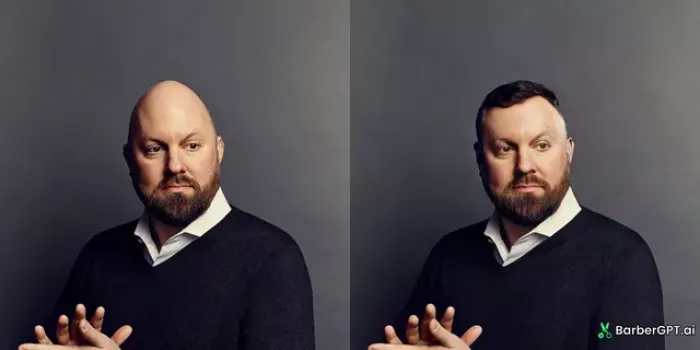
At a technical level BarberGPT combines image preprocessing, a user-directed masking step, and a generative model trained to synthesize hair texture and lighting consistent with the source photo. The emphasis on a masking tool indicates the model is conditional, success depends on accurate delineation of the hair region, which the model uses to replace pixels while preserving facial geometry and ambient shadows. The narrow domain lets the model optimize specifically for men’s hair physics rather than attempting one-size-fits-all hair generation.
Workflow and ease of use
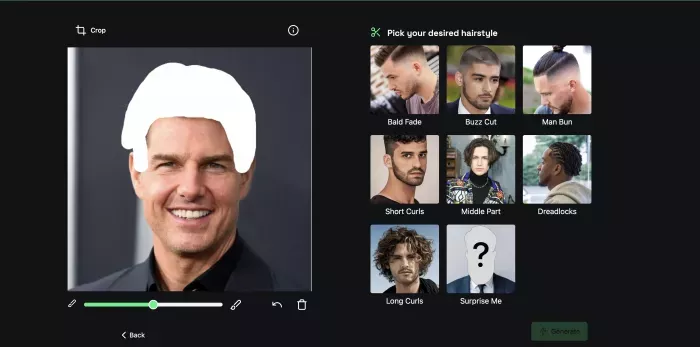
- One-page web editor keeps friction low: upload, mask, choose a style, generate.
- Masking requirement makes the process semi-manual; the mask defines the region the model will alter.
- Three free attempts on initial visits lower the barrier for first-time explorations.
- Desktop-first interaction: masking is more precise on larger screens; mobile is supported but less convenient for fine masking.
These design choices prioritize speed and clarity over automation. The product’s reliance on manual masking signals an explicit trade-off: better control for the user in exchange for more upfront effort.
Pricing and commercial model
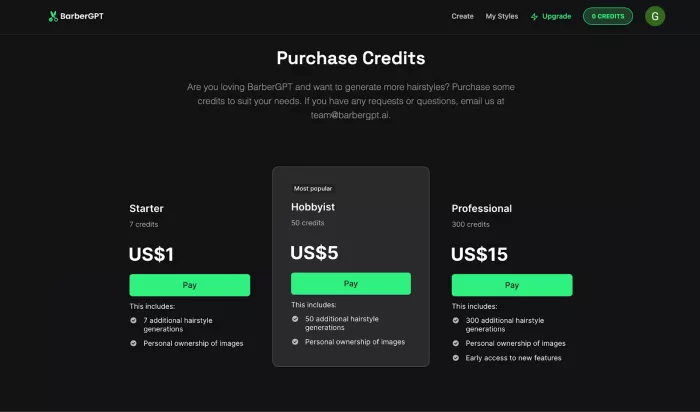
- Credit-based, pay as you go: small credit packs reduce commitment for infrequent users.
- Bulk credit discounts make repeated use economical for hobbyist and pro users.
- No mandatory subscription keeps churn friction low and matches the tool’s episodic use case (a haircut preview every few months).
This pricing fits the product positioning: a lightweight utility rather than an enterprise service. For heavy experimentation the credit model remains cost-effective compared with subscription-based imaging suites.
Output characteristics and realistic expectations
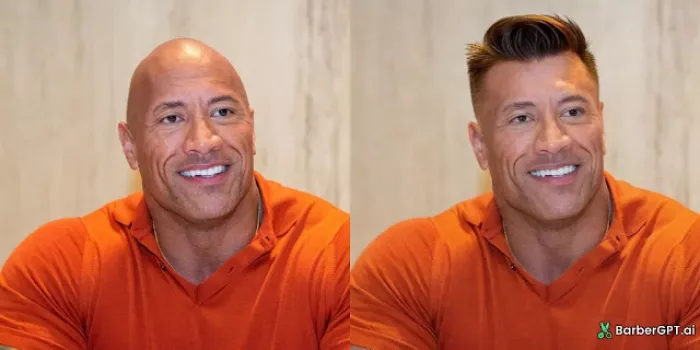
BarberGPT’s outputs tend to be most convincing on short, well-defined haircuts such as buzz cuts and fades. These styles reduce the number of complex interactions between hair and body, which lowers the model’s failure modes. Longer or highly textured styles such as dreadlocks or braided buns reveal the model’s limitations: hair-to-body blending and strand-level realism can appear synthetic or layered incorrectly. Two systematic drivers explain this:
1. Complex geometry: long hair introduces occlusion, motion, and volumetric shading that are harder to infer from a single 2D image.
2. Mask fidelity: the mask must include relevant shoulders and neck for longer styles, otherwise hair can appear detached.
The practical consequence is straightforward: BarberGPT is a reliable decision aid for conservative to moderate changes, and a rough guide for radical transformations.
Privacy and data handling
● No-account trial and manual deletion lower the risk surface for casual users.
● Image ownership claims: the site states generated images belong to the uploader and offers deletion controls.
● Transport security: HTTPS and an SSL certificate are present, which is the baseline expectation for image uploads.
These signals are positive but not exhaustive. For users with high privacy concerns (professional identities, public figures), a further check of retention policies and any third-party model host agreements is prudent before uploading sensitive images.
What Reviews Say About BarberGPT
Across different AI-tool directories and review sites, BarberGPT is generally described as a simple browser-based hairstyle visualization tool that focuses specifically on men’s haircuts. Most reviews highlight the same core workflow: users upload a clear photo of themselves, mark the hair region, and let the system generate previews of various hairstyles such as fades, buzz cuts, dreadlocks, or man buns directly on their face.
Reviewers often note that the tool’s biggest strength is its ease of use and quick experimentation. Because the platform runs entirely in a web browser, there is no software installation required, and beginners can generate hairstyle previews within seconds. The AI attempts to adapt hairstyles to the user’s facial structure and lighting conditions, which can produce fairly realistic previews compared with simple filter-based apps.
At the same time, most reviews also point out that BarberGPT remains a niche utility rather than a complete styling platform. Its capabilities are mainly limited to haircut simulation, and the accuracy of the generated styles depends heavily on the quality of the uploaded photo and how carefully the user marks the hair area. Some analyses also mention that the service typically uses a credit-based system for additional generations after a small free allowance, which may discourage frequent experimentation.
Taken together, the overall sentiment from available reviews suggests that BarberGPT works best as a visual planning tool before visiting a barber, helping users explore haircut ideas without committing to a real change. It performs well within that narrow role, but it should be viewed as a preview generator rather than a professional styling or grooming solution.
Market placement and alternatives (compact comparison)
The product sits between hobbyist mobile apps and pro-grade studio tools. Below is a concise table comparing BarberGPT with commonly referenced alternatives.
| Tool | Focus | Strength vs BarberGPT | Weakness vs BarberGPT |
| AIEase AI | Inclusive hairstyles | Wider gender and texture coverage | Less streamlined for quick male cuts |
| YouCam Makeup | Mobile makeover | Real-time filters, color and beard options | Less precision for professional previews |
| Hairstyle AI (pro services) | High-res previews | Batch consistency for pros | Paid-only, higher cost per image |
This placement clarifies the buyer decision: choose BarberGPT for single-purpose, low-friction male haircut previews; choose alternatives when the requirement is gender-inclusive styling, live mobile filters, or professional batch production.
Practical guidance for prospective users
BarberGPT is best used with these constraints in mind:
- Prefer well-lit, front-facing photos with neutral backgrounds to maximize model accuracy.
- Use desktop for precision masking, especially for long-hair styles.
- Treat results as visual aids to guide discussions with a barber rather than a guarantee of outcome.
- Review retention and deletion policies if anonymity or professional privacy is required.
Bottom line
BarberGPT is a purpose-built visualization utility that delivers on a narrow promise: quick, photoreal previews of common male haircuts. The product’s strengths are simplicity, affordable pay-as-you-go pricing, and fast output for short styles. The primary limitations are mask-dependence, reduced realism on complex long styles, and a constrained feature set that excludes beards, color edits, and female hair modeling. For someone seeking a rapid, inexpensive way to preview classic men’s cuts, BarberGPT represents a practical tool. For broader makeover needs or studio-grade renders, more versatile or higher-end alternatives are the sensible choice.

Comments